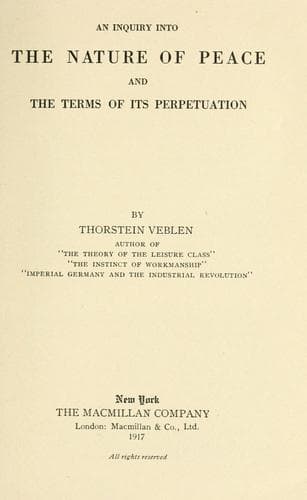
An Inquiry into the Nature of Peace and the Terms of Its PerpetuationVeblen, Thorstein
Philosophy
An Inquiry into the Nature of Peace and the Terms of Its Perpetuation
Veblen, Thorstein
Peace; World War, 1914-1918 -- Peace
Yet it is not to be overlooked that private enterprise on the basis of
private ownership is the familiar and accepted method of conducting
industrial affairs, and that it has the sanction of immemorial usage, in
the eyes of the common man, and that it is reenforced with the urgency
of life and death in the apprehension of the kept classes. It should
accordingly be a possible outcome of such a peace as would put away
international dissension, that the division of classes would come on in
a new form, between those who stand on their ancient rights of
exploitation and mastery, and those who are unwilling longer to submit.
And it is quite within the possibilities of the case that the division
of opinion on these matters might presently shift back to the old
familiar ground of international hostilities; undertaken partly to put
down civil disturbances in given countries, partly by the more archaic,
or conservative, peoples to safeguard the institutions of the received
law and order against inroads from the side of the iconoclastic ones.
* * * * *
In the apprehension of those who are speaking for peace between the
nations and planning for its realisation, the outlook is that of a
return to, or a continuance of, the state of things before the great war
came on, with peace and national security added, or with the danger of
war eliminated. Nothing appreciable in the way of consequent innovation,
certainly nothing of a serious character, is contemplated as being among
the necessary consequences of such a move into peace and security.
National integrity and autonomy are to be preserved on the received
lines, and international division and discrimination is to be managed as
before, and with the accustomed incidents of punctilio and pecuniary
equilibration. Internationally speaking, there is to dawn an era of
diplomacy without afterthought, whatever that might conceivably mean.
There is much in the present situation that speaks for such an
arrangement, particularly as an initial phase of the perpetual peace
that is aimed at, whatever excursive variations might befall presently,
in the course of years. The war experience in the belligerent countries
and the alarm that has disturbed the neutral nations have visibly raised
the pitch of patriotic solidarity in all these countries; and patriotism
greatly favors the conservation of established use and wont; more
particularly is it favorable to the established powers and policies of
the national government. The patriotic spirit is not a spirit of
innovation. The chances of survival, and indeed of stabilisation, for
the accepted use and wont and for the traditional distinctions of class
and prescriptive rights, should therefore seem favorable, at any rate in
the first instance.
Public-domain text, read in full here on John Shaqi.
Reviews
Reviews
No reviews yet
Be the first to share your thoughts on this work.
Elsewhere in the archive
Join the Discussion
Join the discussion
Sign in to leave a comment or review.
Sign InorCreate an account