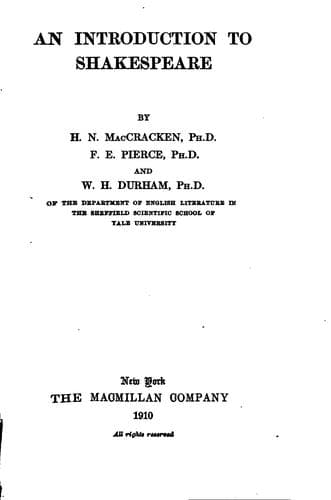
An Introduction to ShakespeareMacCracken, H. N. (Henry Noble)
General
An Introduction to Shakespeare
MacCracken, H. N. (Henry Noble)
Shakespeare, William, 1564-1616 -- Handbooks, manuals, etc.
In this last play there is, it should be said, not the slightest hint
of a weakening of the poetic or the dramatic faculty. The falling in
love of Miranda, the wonderful and wondering child of purity and
nature; the tempting of Sebastian by the crafty Antonio; and the
creation of Caliban, half-man, half-devil, with his elemental knowledge
of nature, and his dull cunning, and his stunted faculties,--all these
are the work of {207} a genius still in the full pride of power.
Shakespeare's dramatic work ends suddenly, "like a bright exhalation in
the evening."
+Date+.--Edmund Malone's word, unsupported by other evidence, puts the
play as already in existence in the autumn of 1611. The play certainly
is later than the wreck of Somers's ship, in 1609. It was acted during
the marriage festivities of the Princess Elizabeth in 1613, when other
plays were revived.
+Sources+.--Two accounts by Sylvester Jourdan and William Strachey
told, soon after the event, of the casting away upon the Bermuda
Islands of a ship belonging to the Virginia expedition of Somers in
1609. From these Shakespeare drew for many details. His island,
however, is clearly not Bermuda, nor, indeed, any known land. Other
details have been traced from various sources. Ariel is a name of a
spirit in mediaeval literature of cabalistic secrets. Montaigne's
_Essays_, translated by Florio (1603), furnished the hint of Gonzalo's
imaginary commonwealth (II, i, 147 ff.). Setebos has been found as a
devil-god of the Patagonians in Eden's _History of Travaile_ (1577).
The rest of the story, which is nine-tenths of the whole, is probably
Shakespeare's own, though the central theme of an exiled prince, whose
daughter marries his enemy, who has an attendant spirit, and who
through magic compels the captive prince to carry logs, may come from
some old folk tale; since a German play, _Die Schöne Sidea_, by Jakob
Ayrer of Nuremberg (died 1605), possesses all these details. The
relations, if any, between the two plays are remote.
+The Life of Henry the Eighth+, the last of the historical plays, in
date of composition as in the history it pictures, suffers from the
very fact that it boasts in its second title, _All is True_. The play
might have been built around any one of the half-dozen persons which in
turn claim our chief interest,--Buckingham, Queen Katherine, Anne
Bullen; the King, Wolsey, or {208} Cranmer; but fidelity to history,
while it did not hinder some slight alteration of incident and time,
required that each of these should in turn be distinguished, if a
complete picture of the times of Henry VIII were to be given. The
result was a complete abandonment of anything like unity of theme.
Public-domain text, read in full here on John Shaqi.
Reviews
Reviews
No reviews yet
Be the first to share your thoughts on this work.
Elsewhere in the archive
Join the Discussion
Join the discussion
Sign in to leave a comment or review.
Sign InorCreate an account