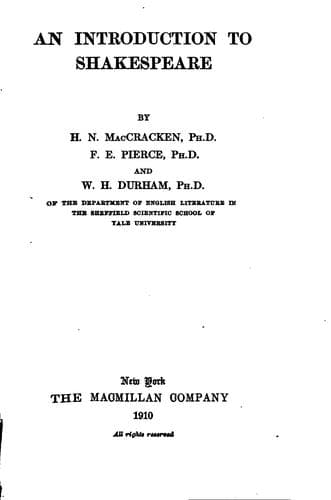
An Introduction to ShakespeareMacCracken, H. N. (Henry Noble)
General
An Introduction to Shakespeare
MacCracken, H. N. (Henry Noble)
Shakespeare, William, 1564-1616 -- Handbooks, manuals, etc.
It is, of course, a disappointment to one who has just read _I Henry
IV_. On the other hand, this play may be regarded as a kind of
pageant, as the word is used nowadays in England and America. It
presents, in the manner of a modern pageant, a series of brilliant
scenes telling of Buckingham's fall, of Wolsey's triumph and ruin, of
Katherine's trial and death, of Anne Bullen's coronation, and of
Cranmer's advancement, joined together by the well-drawn character of
the King, powerful, masterful, selfish, and vindictive, but not without
a suggestion of better qualities. The gayety of the Masque, in the
first act, where King Henry first meets Anne Bullen, is also in perfect
harmony with the modern pageant, which always employs music and dancing
as aids to the picture.
In Queen Katherine we have a suffering and wronged woman, gifted with
queenly grace and dignity, and with strong sympathies and a keen sense
of justice. From her first entrance, when she ventures, Esther-like,
into the presence of the king to intercede for an oppressed people,
through all her vain struggle against the King's wayward inclination
and the Cardinal's wiles, up to the very moment when she is stricken
with mortal illness, she holds our sympathy. If in her great trial
scene she is weaker and more impulsive than Hermione in hers, yet the
circumstances are {209} different; she is not keyed up to so high an
endeavor as that lady, nor in so much danger for herself or her
children.
+Authorship+.--Differences in style and meter, and the fragmentary
quality of the whole play have long confirmed the theory that
Shakespeare in _Henry VIII_ engaged in a very loose sort of
collaboration. Only the Buckingham scene (I, i,), the scenes of
Katherine's entrance and trial (I, ii, II, iv), a brief scene of Anne
Bullen (II, iii), and the first half of the scene in which Wolsey's
schemes are exposed and Henry alienated from him (III, i, 1-203) are
confidently ascribed to Shakespeare. The rest of the play fits best
the style and metrical habit of John Fletcher, at this time one of the
most popular dramatists of London.
+Date+.--The Globe Theater was burned on June 29, 1613, when a play
called _Henry VIII or All is True_ was being performed. So far as
stylistic tests can decide, this was not long after the composition of
the play. Sir Henry Wotton, the antiquarian, writing from hearsay
knowledge, says that the play being acted at the time of the fire was
"a new play called All is True." Shakespeare's scenes in this drama
may thus have been his last dramatic work. A praise of King James in
the last scene was probably written not later than the rest of the
play, and thus insures a date later than 1603. The earliest print of
the play was the First Folio, 1623.
+Source+.--Holinshed was the chief source. Halle furnished certain
details. Foxe's _Book of Martyrs_ tells the Cranmer story.
{210}
CHAPTER XIV
FAMOUS MISTAKES AND DELUSIONS ABOUT SHAKESPEARE
Public-domain text, read in full here on John Shaqi.
Reviews
Reviews
No reviews yet
Be the first to share your thoughts on this work.
Elsewhere in the archive
Join the Discussion
Join the discussion
Sign in to leave a comment or review.
Sign InorCreate an account