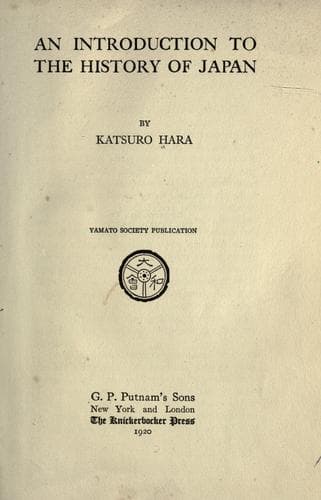
An Introduction to the History of JapanHara, Katsuro
History
An Introduction to the History of Japan
Hara, Katsuro
Japan -- History
Produced by Adrian Mastronardi, Ernest Schaal, and the
Online Distributed Proofreading Team at https://www.pgdp.net
(This file was produced from images generously made
available by The Internet Archive/American Libraries.)
AN INTRODUCTION TO
THE HISTORY OF JAPAN
BY
KATSURO HARA
YAMATO SOCIETY PUBLICATION
[Illustration]
G. P. Putnam's Sons
New York and London
The Knickerbocker Press
1920
COPYRIGHT, 1920, BY
THE YAMATO SOCIETY
OBJECTS OF THE YAMATO SOCIETY
The military achievements of Japan in the last twenty years have done
much to make the world appreciate and acknowledge the intrinsic worth of
the Japanese nation. It is, however, very doubtful whether the other
nations find in us many other things to admire besides our military
excellence. Some of them, indeed, without fully investigating their
deeper causes, have entertained serious misgivings as to the probable
consequence of our military successes. The continual occurrence of
anti-Japanese movements in the various States of America and in the
dependencies of Great Britain and Russia, countries with which Japan is
most intimately connected, has been chiefly due to this want of
knowledge as to the real state of affairs in Japan, the progress in the
arts of peace, in science, literature, art, law and economics.
Japan has a brilliant civilisation of which we can justly be proud. In
fine art, we have painting, sculpture, architecture, lacquer-work,
metal-carving, ceramics, etc.,--all of striking quality; in literature,
our poetry, fiction and drama are worthy of serious study; in music and
on the stage our progress has been along lines which accord with the
development of our distinctive national character, and is by no means
behind that of Europe.
Europeans and Americans, however, have failed as yet to appreciate the
essential worth of Japan's civilisation. Some foreigners, it is true,
speak highly of Japanese fine art, praising Japan as a country devoted
to art; but the works that they admire are not always essentially
characteristic of Japan, nor are they representative works of Japanese
fine arts. The number of foreigners aware of the existence of an
influential literature in Japan is extremely limited.
Public-domain text, read in full here on John Shaqi.
Reviews
Reviews
No reviews yet
Be the first to share your thoughts on this work.
Join the Discussion
Join the discussion
Sign in to leave a comment or review.
Sign InorCreate an account