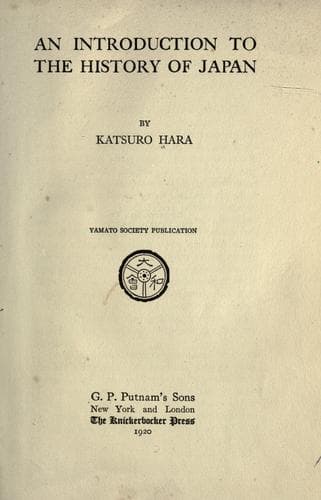
An Introduction to the History of JapanHara, Katsuro
History
An Introduction to the History of Japan
Hara, Katsuro
Japan -- History
The flourishing period of the Taira family was of the short duration of
thirty years only. As the rise of the family was very sudden, its
downfall was equally abrupt. It was like a meteor traversing a corner of
the long history of Japan, leaving, however, an indelible memory to
posterity. The peculiar charm of the culture of the age represented by
the elite of the family during its ascendency, and its chivalrous end,
embellish the history of our country with a number of pathetic episodes
which provided abundant themes for poems, tales, and dramas of the
after-age. The most famous among this literature is a narration called
the _Heike-monogatari_, Heike in Chinese characters meaning "the family
of Taira." Whether the _monogatari_ or tale was first composed for the
purpose of being read or recited is a question. It is certain, however,
that when the story became widely known, called by the more simplified
name of "the _Heike_," it was generally recited as a chant, resembling
the melody of Buddhist hymns, accompanied by the playing the _biwa_, a
stringed instrument the shape of which has given its name to the largest
lake in Japan. This recitation is the precursor of the _utai_, which was
a kind of recitation fashionable in the next age. The origin of the more
modern _joruri_ recitation accompanied by the _shamisen_ may be traced
to the _Heike_ also. What pleased the audiences most in the _Heike_ were
the sad vicissitudes of the family and the gallant chivalry manifested
in its downfall. The former, preaching the uncertainty of human life,
was sufficient to touch the courtiers with keen pathos, courtiers who
had lived out their time, and having been taught by Buddhism to look on
every thing pessimistically, were glad to sympathise with whatever was
on the wane. Differently from them, warriors were also fond of hearing
the rehearsal of the _Heike_ with thrills piercing the heart, by putting
themselves in the place of some gallant Taira cavalier, who had fought
to the last with undaunted courage and met his death with calmness more
than mortal.
Public-domain text, read in full here on John Shaqi.
Reviews
Reviews
No reviews yet
Be the first to share your thoughts on this work.
Elsewhere in the archive
Join the Discussion
Join the discussion
Sign in to leave a comment or review.
Sign InorCreate an account