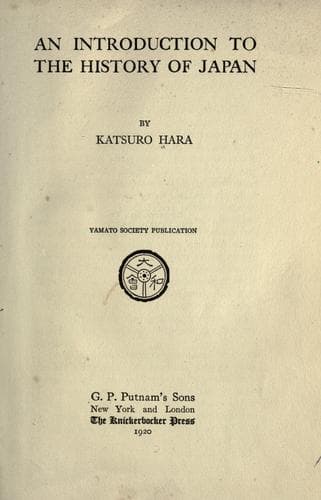
An Introduction to the History of JapanHara, Katsuro
History
An Introduction to the History of Japan
Hara, Katsuro
Japan -- History
It is not only because the Taira family was in general more refined than
the Minamoto, and gave an impulse to the literature of Japan by its
enlightened chivalry, that the period forms an important turning-point
in the history of the civilisation of our country. Almost all the
essential traits of our civilisation during the whole military regime
can be said to have been initiated in this brief Taira epoch. As an
inheritor of the borrowed civilisation, the Taira warriors were not so
much saturated with the alien refinement as the Fujiwara nobles were,
and therefore, when they came nearer the throne, the aspect of the court
was not a little vulgarised, but instead there was a freshness in those
warriors which was found wanting among the Fujiwara, already overwrought
and exhausted by too much Chinese civilisation. This freshness may be
considered an index of the revival of the conservative spirit, which had
been long lurking in the lower strata of the nation. Conservatism in
such a phase of history is generally on the side of strength and energy.
It is true that Kiyomori, his sons, and grandsons endeavoured rather to
go up the ladder of the courtiers higher and higher, in order to soar
'above the cloud.' In other words, it was not their first ambition to
lead the people in the lower strata against the higher; they were not
revolutionists at all. But whatever might have been their real
intention, they could not ward off those followers who had a common
interest with them. There was no doubt that the lower class of people
sympathised with the military-men, whether they were of the Taira or of
the Minamoto family, far more deeply than with the Fujiwara nobles. The
ascendency, therefore, of the Taira stirred the long latent spirit of
the majority of the nation, and this re-awakening of the Japanese, if we
may call it so, gave life to every fibre of the social structure, urging
the nation to energetic movement.
The most tangible evidence of this resuscitation of Japan can be
obtained in the sculpture of the age. The first flourishing period of
Japanese sculpture anterior to this is the era of the Tempyo, that is to
say, during the reign of the Emperor Shomu. After that the art fell
gradually into decadence, and no period could compete with the Tempyo
era except the Taira age. The works of Unkei and Tankei, representative
masters who made their names at this time, though lagging far behind
those of Tempyo sculptors in exquisite softness and serenity, yet
surpassed the latter in vigour and strength. What they liked to
represent most were statues of deities rather than Buddha himself, and
of the deities they preferred those of martial character. Comparing
them with the Tempyo sculptures, in which the subject is not so narrowly
circumscribed, we can observe the change of the national spirit very
clearly.
Public-domain text, read in full here on John Shaqi.
Reviews
Reviews
No reviews yet
Be the first to share your thoughts on this work.
Elsewhere in the archive
Join the Discussion
Join the discussion
Sign in to leave a comment or review.
Sign InorCreate an account