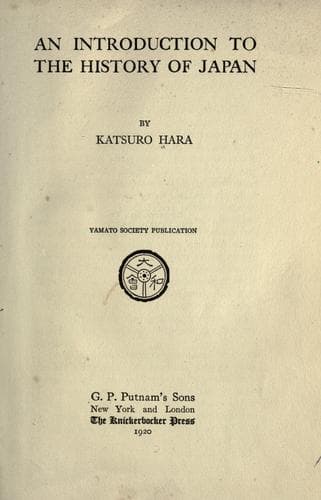
An Introduction to the History of JapanHara, Katsuro
History
An Introduction to the History of Japan
Hara, Katsuro
Japan -- History
object in partially supplanting the influence of the Fujiwara, but it
could not perceptibly weaken the latter. The downfall of the Taira
showed clearly that in such a state of the country mere names and titles
meant practically nothing, and that the military power supported by
material resources was the thing most worth coveting. The Taira started
on this line, but soon collapsed by abandoning it. How could a shrewd
politician like Yoritomo be expected to imitate the blunder of his
opponent?
The Shogunate set up by Yoritomo at Kamakura was not of the sort which
could appropriately be called a regularly organised government. It was
modelled after the organisation of a family-business office, which was
common to all the noble families of high rank. There were several
functionaries in the Shogunate, but they had the character rather of
private servants than of state officials. The Shogun's secretaries,
body-guards, butlers and so forth served under him not on account of any
official regulation connecting them publicly with him, but only as his
retainers, and were designated by the name of the _go-kenin_, which
means "the men of the august household." To sum up, the Shogunate was
established not for the state but for the family business. Yoritomo had
never pretended to take possession of the government of Japan. The fact
that at the beginning of the Shogunate its jurisdiction did not extend
over the whole of the empire testifies to the same.
In the foregoing chapters I have spoken about the encroachment on public
lands by the Fujiwara nobles. The private farms which were called the
_sho-yen_ and resembled in their character the manors or great landed
estates in England, increased year by year, so that they extended at
last to all the distant provinces of the country. Some emperors were
resolute enough to try to put a stop to the growth of this onerous
infringement of the public property, but the orders issued by them had
very little effect. As to the management of these farms, they were not
administered directly by those nobles who owned them, and it was not
uncommon for many manors lying far apart from one another to belong to
the same owner. The proprietors, therefore, generally stationed some of
their domestic servants in those manors to act as caretakers, or
confided the management to men who were the original reclaimers of those
manors or their descendants, from whom the nobles had received the lands
as a donation. By this assumption of the duty of management, these
servants of these nobles arrogated to themselves the right to govern and
command the people living upon the estates, without any appointment from
the government itself. It cannot be disputed that it was a kind of
usurpation not allowable in the regular state of any organised country.
The provincial governors of that time, however, were impotent to put a
bridle on those impudent managers, for most of the governors appointed
Public-domain text, read in full here on John Shaqi.
Reviews
Reviews
No reviews yet
Be the first to share your thoughts on this work.
Elsewhere in the archive
Join the Discussion
Join the discussion
Sign in to leave a comment or review.
Sign InorCreate an account