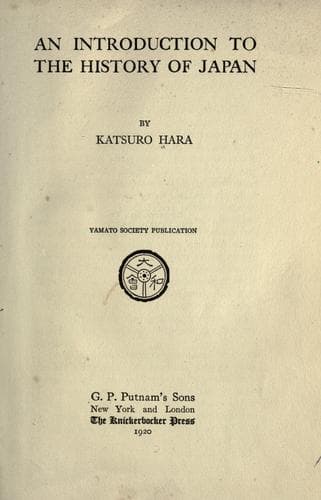
An Introduction to the History of JapanHara, Katsuro
History
An Introduction to the History of Japan
Hara, Katsuro
Japan -- History
stayed in Kyoto to enjoy the pleasure of city life, and left the
business of the province to be administered by their lieutenants.
Moreover, some of the manors were evidently exempted from the
intervention of the provincial officials by a special order. In other
words, most of the manors were communities which were to a great degree
autonomous, each under the jurisdiction of a half independent manager,
and that manager again standing in a subordinate position to his patron,
who resided generally at Kyoto. So far I have spoken only of the manors
belonging to the nobles of the higher class, including members of the
imperial family. Other manors possessed by Shinto shrines and Buddhist
temples were also under a regime not much different from those of the
nobles. The Taira, too, at the zenith of their family power, had a great
number of such estates and the sons of Kiyomori fought against the
Minamoto with forces recruited from the tenants of those manors.
When Yoritomo overcame the Taira, he confiscated all the manors which
had formerly been possessed by that family, and appointed one of his
retainers to each of these appropriated manors as _djito_, which
literally means a chief of the land. The duty of these _djito_ was to
collect for their lord Shogun a certain amount of rice, proportional to
the area of the rice fields belonging to the estate. This reserved rice
was destined to be used as provision for soldiers, and was in reality
the income of the _djito_, for he was himself the very soldier who would
use that rice as provision. Besides the collection of rice, he had to
keep in order the manor to which he had been appointed as chief, that is
to say, the police of the manor was in his hands. Once appointed, a
_djito_ could make his office hereditary, though for this the sanction
of the Shogunate was necessary. Yoritomo appointed also a military
governor to each of the provinces. The authority of this governor,
called the _shugo_, extended over all the retainers of the Shogun in
that province, including the _djito_. It should be noticed, however,
that the _shugo_ was as a rule a warrior, who held the office of _djito_
at the same time, in or out of that province.
Public-domain text, read in full here on John Shaqi.
Reviews
Reviews
No reviews yet
Be the first to share your thoughts on this work.
Elsewhere in the archive
Join the Discussion
Join the discussion
Sign in to leave a comment or review.
Sign InorCreate an account