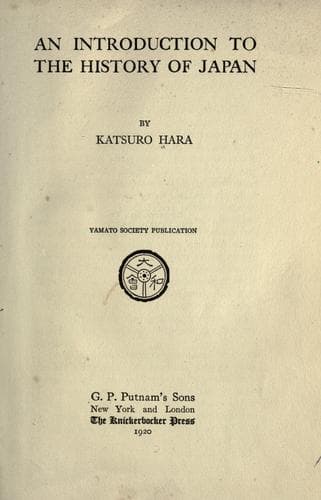
An Introduction to the History of JapanHara, Katsuro
History
An Introduction to the History of Japan
Hara, Katsuro
Japan -- History
As to the manors which were owned by Kyoto nobles, shrines, and temples,
and therefore not at the disposal of the Shogun, no _djito_ was
appointed to them. Though the disputes about the boundaries, right of
inheritance, and various other questions concerning the estates were
decided by the legal councillors of the Shogunate, jurisdiction was
restricted to those cases in which some retainer of the Shogun was a
party. Otherwise, the right of decision was denied by the Shogun. The
Shogun never claimed any right over the land which did not stand
expressly under his jurisdiction. From this it can be inferred that he
did not pretend to take over the civil government of the whole of
Japan. By the foundation of the Shogunate, however, Yoritomo became a
very powerful military chief, sanctioned by the Emperor with the
conferment of the title of "generalissimo to chastise the Ainu", and at
need he was able to mobilise a large number of soldiers, by giving
orders to _djito_ through the _shugo_ of the provinces. None was able to
compete with him in military strength, and the business of the civil
government had necessarily to fall into the hands of him who was the
strongest in material force.
If such an anomalous state, as we see in the beginning of the Shogunate,
had continued very long, the Shogunate would never have become the
regular government of the country, and the dismemberment of Japan might
have been the ultimate result. But fortunately for the future of our
country, it did not remain as it was first established. Those managers
of manors not belonging to the Shogun, seeing that they could be better
protected from above by turning themselves into retainers of the Shogun,
volunteered for his service. Nobles, shrines, and temples possessing
these manors complained of course about the enlistment of the
manor-managers into the Shogunate service. For by the transformation of
the managers, those manors _ipso facto_ came under the military
jurisdiction of Kamakura. As those owners, however, could not prevent
the transformation, and as the income from those estates did not
decrease in any great measure by the extension of the jurisdiction of
the Shogun over them, they had nothing to do, but tacitly to acquiesce
in the new conditions. The number of retainers thus increased rapidly,
and with it the Shogunate's sphere of jurisdiction grew wider and wider,
till at last it covered the greater part of the Empire. The Shogunate
was then no more a mere business office of a family, but the government
_de facto_ recognised by the whole nation. This process was consummated
in the middle of the first half of the thirteenth century.
Public-domain text, read in full here on John Shaqi.
Reviews
Reviews
No reviews yet
Be the first to share your thoughts on this work.
Elsewhere in the archive
Join the Discussion
Join the discussion
Sign in to leave a comment or review.
Sign InorCreate an account