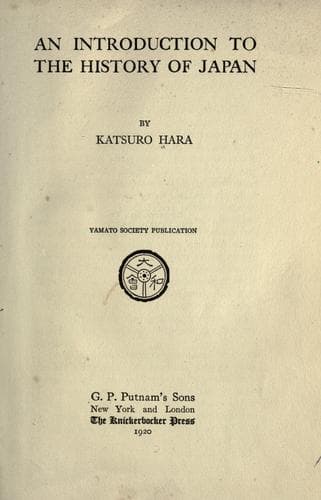
An Introduction to the History of JapanHara, Katsuro
History
An Introduction to the History of Japan
Hara, Katsuro
Japan -- History
In the time of the Kamakura Shogunate, as aforesaid, each province had a
military governor, called the _shugo_, appointed by the Shogun. The
_shugo_, himself a _djito_, and a very influential one of that class,
served as an intermediate commander in transmitting to the _djito_ under
him the military instructions which he had received from Kamakura. He
was, therefore, nothing else but a marshal of all the _djito_ within
that province. There existed no relation of vassalage between him and
the _djito_ under his military jurisdiction. The latter remained to the
end the direct vassals of the Shogunate at Kamakura, and only as regards
the military organisation were subordinated to the _shugo_. The office
of the _shugo_ was not the hereditary possession of any family, so that
the Shogun could nominate any _djito_ to be _shugo_ of any province at
his pleasure, without fear of disturbing thereby the personal relation
between him and his retainers in that province. In some respects this
relation resembled that of the English king and the barons, who swore,
besides their oath of fealty to a higher noble as their liege lord,
direct allegiance to their king. As long as the line of Yoritomo,
therefore, continued as hereditary Shogun, the Shogunate could depend on
the fidelity of those _djito_, who were but the household vassals of the
Minamoto family, and by this personal tie keep the political unity of
the country infrangible.
After the extinction of the Minamoto family, the Shogun who succeeded
one after another had no hereditary nor personal relations with those
_djito_, and could claim no more than the official prestige of the
Shogun allowed them to do. As to the Hojo family, though the real power
of the Shogunate was in its hands, originally it was no higher in rank
than the _djito_, and could not, in its own name, command obedience from
any of the Shogun's retainers. There is some similarity between the
organisation of the time of the Kamakura Shogunate in this second phase
and the "Kreis" institution of the German empire in the fifteenth
century, which was initiated with the object of political concentration
by Maximilian I., whose real power lay in his being a duke of Austria,
and not Emperor of Germany. However admirable as an organisation, such
a political status was undoubtedly untenable. No wonder that the
military regime of Kamakura gradually collapsed.
Public-domain text, read in full here on John Shaqi.
Reviews
Reviews
No reviews yet
Be the first to share your thoughts on this work.
Elsewhere in the archive
Join the Discussion
Join the discussion
Sign in to leave a comment or review.
Sign InorCreate an account