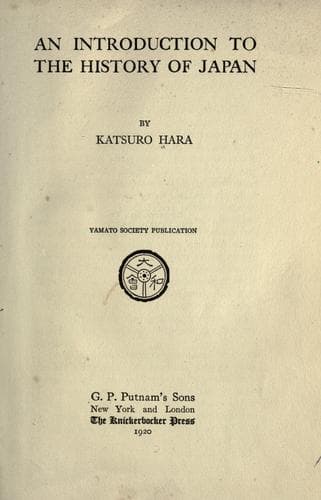
An Introduction to the History of JapanHara, Katsuro
History
An Introduction to the History of Japan
Hara, Katsuro
Japan -- History
The relation of _shugo_ and _djito_ in the time of the Ashikaga was
quite of a different sort from that in the former Shogunate. The office
of _shugo_ became now the hereditary possession of certain privileged
families, which constituted a body of higher warriors, towering above
the common _djito_. The _shugo_ stood in the position of protector to
all the _djito_ of the province he governed, and those _djito_ who stood
under a _shugo_ were designated his "hikwan" or proteges. The relation
of vassalage arose thus between the _shugo_ and the _djito_ in the same
province, a legal status which had not existed in the Kamakura period.
The direct relation between the common _djito_ and the Shogun, which was
the main spring of the political regime of the Kamakura era, was now cut
off. No doubt the _shugo_ in the Ashikaga period had in their provinces,
besides their suzerainty over the _djito_, the tenure of certain tracts
of land, as in the days of Kamakura. The great difference between them,
however, was that in the Kamakura era a retainer of the Shogun was first
installed as a _djito_ of a manor, and then appointed _shugo_, while in
the Ashikaga age the land which the _shugo_ held directly was his
demesne as _shugo_ and not the land held as a retainer of the Shogun at
Kyoto, independent of his office of _shugo_. To sum up, the _shugo_ of
the Ashikaga period was not a mere office, as in the days of Kamakura,
but a legal status of the warriors ranking next to the Shogun. As the
result of such an organisation each province or group of provinces under
a _shugo_ became a political entity, while it had been but a military
entity in the Kamakura era. If the Shogun at Kyoto, therefore, had been
strong enough to enforce his will over all the _shugo_ of the provinces,
then the political unity of the country at large could safely continue
in the hands of the Ashikaga.
The Shogunate of the Ashikaga, however, had not been originally so
formulated as to enable it to impose implicit obedience on all the
higher military officials of the _shugo_ class. For this family, though
a branch of the Minamoto, had nothing in its history that could attract,
as Yoritomo did, a vast number of willing warriors to serve under its
banner. That Takauji was promoted to the headship of the second military
government was largely due to the assistance of the warriors from
various parts of the empire who were not personally related to his
family, but were disaffected at seeing the power of the courtiers
restored, neither was it by any means to be attributed to his personal
capacity, which was rather mediocre both as general and as statesman.
This origin of the Ashikaga family, therefore, made it difficult from
the first for the Shogun of the line to curb the arrogance of his
influential generals. Insurrection against the Shogunate followed one
after another, so that no year passed without some small disturbance
somewhere.
Public-domain text, read in full here on John Shaqi.
Reviews
Reviews
No reviews yet
Be the first to share your thoughts on this work.
Elsewhere in the archive
Join the Discussion
Join the discussion
Sign in to leave a comment or review.
Sign InorCreate an account