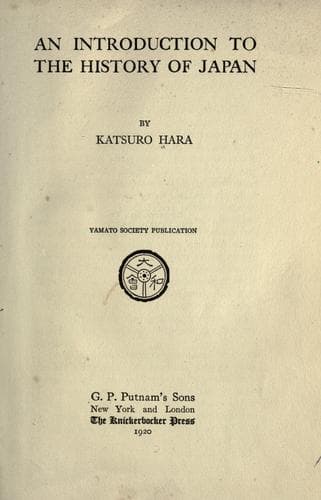
An Introduction to the History of JapanHara, Katsuro
History
An Introduction to the History of Japan
Hara, Katsuro
Japan -- History
The expedition of Yoshihisa was an epoch-making event in the history of
our country. To support by military power the courtiers, whose cup had
already begun to run over and whose interests could not be always
consistent with the welfare of the Shogunate, was evidently a quixotic
attempt. Still it cannot be disputed that Yoshihisa fought at least for
an ideal, however unrealisable it might have been. He reminds us of the
scions of the Hohenstaufen who fought in Italy for the imperial ideal
traditional in their family. The failure of the expedition into Ohmi
meant the utter impossibility of the restoration of the courtiers'
prestige and the approach of the total disappearance of the manorial
system from the islands of Japan. This is a mighty economical change for
the empire, the importance of which could not be overvalued. The old
regime initiated by the reform of the Taikwa was going down to its
grave, and new Japan was beginning to dawn side by side with the
momentous political disintegration of the country. We see, indeed,
simultaneous with this political and economical change, the
transformation of various factors of civilisation, preparing themselves
for the coming age. The first turning of the wheel of history, however,
depended on the political regeneration of the country by a master-hand.
CHAPTER IX
END OF MEDIAEVAL JAPAN
In order to see a nation consolidated, it is necessary not only to have
a nucleus serving as a centre, towards which the whole nation might
converge, but to have at the same time the centralising power of that
nucleus strengthened sufficiently to hold the nation solid and compact.
Moreover, the constituent parts of that nation ought to have the
capacity to respond to the action emanating from that common centre or
nucleus towards those parts, and facilitate the reciprocal relation
between the centralising and the centralised. More than that. There must
be formed strong links between those component parts themselves towards
one another. For if each part be linked only to a common centre and
estranged from other parts, then there is a great danger of the breaking
asunder of the whole, however strong the centralising force of that
nucleus might be, and in case of the debilitation of that sole centre,
there might remain no other force alive to keep the constituent parts
compactly together. To impart, however, the consolidating force to those
component parts, they should be instituted each as a separate organism.
In other words, unless those parts constitute themselves each in an
organic social and political body, provided with the power of acting
within and without, they cannot form any close connection among
themselves and with the central nucleus; and to be provided with such a
power, or to become an organism, each part, too, must have in its turn
its own nucleus, around which the rest of that part might converge. To
Public-domain text, read in full here on John Shaqi.
Reviews
Reviews
No reviews yet
Be the first to share your thoughts on this work.
Elsewhere in the archive
Join the Discussion
Join the discussion
Sign in to leave a comment or review.
Sign InorCreate an account