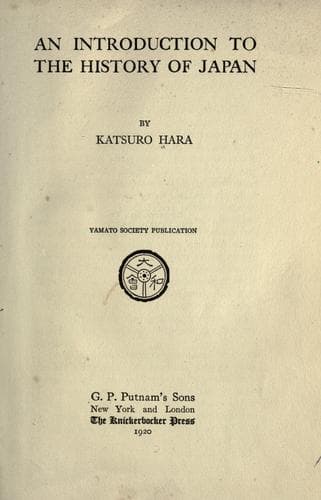
An Introduction to the History of JapanHara, Katsuro
History
An Introduction to the History of Japan
Hara, Katsuro
Japan -- History
speak summarily, for a strong centralisation there must be, besides one
nucleus, or nucleus of the first order, a certain number of nuclei of
the second or minor order, and sometimes there must be nuclei of the
third and lower orders.
It might be deduced from what is said above that without a sufficient
number of local centres, that is to say, without the existence of
well-developed minor political organisms, the political centre, however
powerful it might be, would not be able to hold a country together,
lacking cohesion between those constituent parts. Japan had long been in
such a disorderly state which continued until the middle of the Ashikaga
period, that is to say, the middle of the fifteenth century. The
political influence of Kamakura, though independent of Kyoto, was of
very short duration, and Kyoto had continued on the whole as the sole
political and social centre. If there had been in the provinces a place
worthy to be called a city, besides Kamakura, it could only be sought
in Hakata on the northern coast of Kyushu. Other places were hardly to
be termed cities, being but little more than sites of periodical fairs
at the utmost. The growth of the cities of Sakai and Yamaguchi is of
rather later origin, dating from the middle of the Ashikaga age. The
Emperor, the Shogun, and one metropolitan city had dominated the whole
of the country for a long time, so that, superficially observed, Japan
could be said to have been superbly centralised, and therefore
excellently unified. In reality, however, the prestige of the Emperor
declined, as well as the military power of the Shogunate, and Kyoto, the
site of the imperial court and of the military government, lost the
political influence it once had possessed. After all, nothing was found
influential enough in the earlier Ashikaga age to serve by itself as a
means of solidifying the nation, while there had not yet been formed
those minor provincial centres around which communities of lesser
magnitude might crystallise. Manors, which were the remnants of the
former ages, were of course a kind of agricultural communities, and
could be considered as social and economical units, but they were
politically dependent on their proprietors living in Kyoto or somewhere
else outside of those manors, and in cultural respects most of the
manors counted almost for nothing. All Japan was thus thrown into a
state of chaos, when the military power of the Ashikaga Shogunate was
reduced to impotence.
Public-domain text, read in full here on John Shaqi.
Reviews
Reviews
No reviews yet
Be the first to share your thoughts on this work.
Elsewhere in the archive
Join the Discussion
Join the discussion
Sign in to leave a comment or review.
Sign InorCreate an account