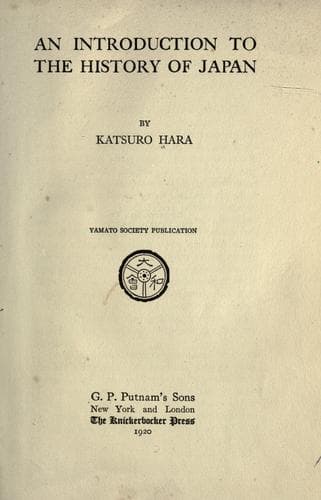
An Introduction to the History of JapanHara, Katsuro
History
An Introduction to the History of Japan
Hara, Katsuro
Japan -- History
This chaotic period of Japanese history has been generally considered as
the retrogressive age of our civilisation, quite in the same sense in
which the medieval age in European history has come to be designated as
the Dark Ages. It is a great mistake, however, to stigmatise the
Ashikaga period as having witnessed no progress in any cultural factor,
just as it has been a fatal misconception of early European historians
to think that medieval Europe was indeed dark in every cultural respect.
Though the classicism of the former ages might seem a civilisation of a
far higher stage when compared with the vulgarised culture of the later,
or so-called Dark Age, yet the vulgarisation should not be necessarily
branded as a backward movement of civilisation. The vulgarisation at
least accompanies a wider propagation, a deeper permeation, and the
better adaptation to the real social condition of the time, and should
not be looked down upon as an absolutely decadent process. In the
seemingly anarchical period of the early Ashikaga, Japan had been
undergoing, in sooth, an important change in social and cultural
respects. Nay, even politically a change of mighty consequence was in
course of evolution. Having reached an extreme state of disorder, a germ
of fresh order was gradually forming itself out of necessity. That the
_shugo_ of this period held sway over a district far more extensive than
the land held by any of the _shugo_ of the Kamakura period, is in a
sense a remarkable political progress. Yamana, one of the most powerful
of the Ashikaga _shugo_, is said to have possessed about one-sixth of the
whole of Japan, and on that account was called Lord One-sixth. Such
great feudatories were never possible in the Kamakura period. Most of
these grand lords, though living mainly in Kyoto, as was stated in the
previous chapter, had their provincial residences, which, too, were not
so unpretentious as those of the _djito_ of the Kamakura. Each lord
maintained princely state, and around his court, a thriving social life
must have grown up, making the beginning of the modern Japanese
provincial towns. The governmental sites of the _daimyo_ or feudatories
of the Tokugawa period generally find the origin of their urban
development in these residences of the _shugo_ of the Ashikaga period.
Public-domain text, read in full here on John Shaqi.
Reviews
Reviews
No reviews yet
Be the first to share your thoughts on this work.
Elsewhere in the archive
Join the Discussion
Join the discussion
Sign in to leave a comment or review.
Sign InorCreate an account