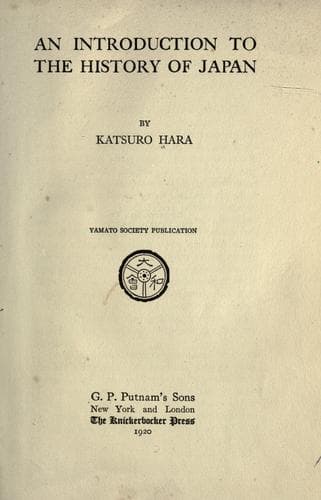
An Introduction to the History of JapanHara, Katsuro
History
An Introduction to the History of Japan
Hara, Katsuro
Japan -- History
What I want to call attention to next is that the history of our country
is not that monotonous repetition of a certain kind of historical data,
however peculiar the data in themselves may be. Nay, the history of
Japan is full of varieties in the nature of its data. The history of
Greece is sometimes stated to be a miniature of the world's history on
account of the richness in variety of the historical phenomena which
occurred there, it being possible to find there also most of the
important subjects treated in history at large, though of course on a
much reduced scale. In this regard, too, the history of Japan closely
resembles that of ancient Greece. Our country had been disunited for a
long time, each section constituting itself a political quasi-unit
governed by a certain local semi-independent lord, like the tyrant of
Greek history. Those local potentates, however, were not so arrogant as
not to recognise the hereditary, political and spiritual sovereignty of
the Emperor. Not only that. They also reluctantly rejected the hegemony
of the Shogunate, though as a matter of fact this had but a nominal
existence. From this point of view, it might be asserted that our
country never ceased to be a united one. The bond of unity, however,
became very slack at intervals, so that the very existence of the unity
itself was often in doubt. In our history, therefore, there were many
obstacles to progress, especially in those lines of progress which
necessarily depend on the close unification of the whole country. At the
same time, however, advantages are not to be neglected, which might be
considered to result from the dismemberment itself. Japan had many small
centres at some periods. But it was, to some extent, owing to similar
circumstances that those centres came into existence, and for that
reason there was to be found much in common in all of them, in respect
of the tone of the culture fostered in the respective centres. That is a
matter of course. Among those centres, however, there arose naturally
much vying with one another in the promotion of their progress, and thus
the general standard of civilisation in Japan came to be raised to a
not inconsiderable height. Moreover, something like international
relations began to grow up between those units, which contributed
largely to the perfection of the culture within each of them. This is
the same interesting phenomenon, which we can trace not in the history
of Greece only, but in that of the Holy Roman Empire, nay, even in the
history of Europe itself. The difference is simply that in Europe the
same phenomenon developed on a grand scale, while it took place in Japan
in a very small compass. No wonder that as a result of having had a
national experience of the nature stated above, the history of Japan is
rich in varieties of data and deserves the attention of highly qualified
historians. So let me here submit to a hasty examination a few of the
Public-domain text, read in full here on John Shaqi.
Reviews
Reviews
No reviews yet
Be the first to share your thoughts on this work.
Join the Discussion
Join the discussion
Sign in to leave a comment or review.
Sign InorCreate an account