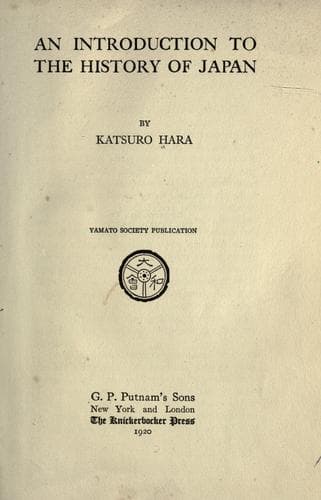
An Introduction to the History of JapanHara, Katsuro
History
An Introduction to the History of Japan
Hara, Katsuro
Japan -- History
The growth of the Japanese cities, actuated by the political and
commercial conditions of the country as stated above, is a phenomenon
which had much to do with the progress of our civilization in general.
Notwithstanding the manifold drawbacks necessarily accompanying urban
life, cities have been, since very ancient times, one of the most potent
agents in the history of the East as well as of the West, in raising the
general standard of culture to a high level. Rural life, whatever
sonorous praise be chanted for it, would not have been able by itself to
elevate the standard of manners and behaviour much above a blunt rustic
naivete. In this respect we can observe a remarkable difference between
the Ashikaga and the preceding ages, a difference quite similar in
nature to that which existed between the eleventh and the twelfth
centuries in the history of Europe. The sudden increase, in Japan, of
printed books in number and variety shows it more than clearly.
The history of printing in Japan goes back to the middle of the eighth
century, but at the beginning the matter printed was limited to detached
leaflets. What was printed the earliest in the form of a book and is
still extant, bears the date of 1088. After that, however, very few
books had been printed for a long time. Moreover, those few were
exclusively religious. It was in the year 1247 that one of the
commentaries on the _Lun-yue_, the famous work of the teachings of
Confucius, was put into a reprint, after the model of a contemporary
Chinese edition, that is to say, of the Sung age. That this
non-religious or non-Buddhist work was first edited in Japan in the
middle of the Kamakura period, proves the enlargement of the circle of
readers in Chinese classics by the participation of the warrior-class.
Such editing of secular Chinese works, however, was discontinued for
three-quarters of a century, and was not resumed until 1322, only ten
years before the outbreak of the long civil war. The book printed at the
latter date was after one of the Chinese editions of the _Shu-king_,
another piece of Confucian literature. This was followed by the
reprinting of many other non-religious Chinese works. The civil war too
astonishes us not only in that it did not hinder the continuance of the
reprints of useful Chinese originals, but also in that the number of
books reprinted has suddenly increased in general since this period.
Among the books issued during the war, a commentary on the _Lun-yue_, of
a text different from that above mentioned, and said to have been made
at Sakai, was the most remarkable. The edition was dated 1364, and
reprinted again and again in several places. In this case the place
where the printing was first undertaken demands also our attention.
Hitherto almost all the books had been published in Kyoto, except some
tomes of Buddhist literature, which occasionally had been edited in the
convents at Nara or Koya. But now printing began to be undertaken not
Public-domain text, read in full here on John Shaqi.
Reviews
Reviews
No reviews yet
Be the first to share your thoughts on this work.
Elsewhere in the archive
Join the Discussion
Join the discussion
Sign in to leave a comment or review.
Sign InorCreate an account