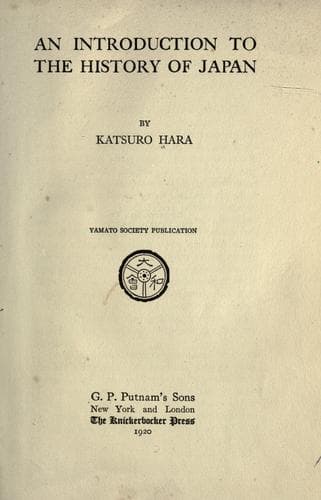
An Introduction to the History of JapanHara, Katsuro
History
An Introduction to the History of Japan
Hara, Katsuro
Japan -- History
only in these historical and sacred places, but in purely commercial
cities of quite recent growth, as Sakai. It is said that about this time
several kinds of books of Chinese literature were edited in the city of
Hakata, and that it was a naturalised Chinese who had started the
undertaking there. Another tradition tells us that two Chinese
block-engravers came and settled at Hakata, and engaged in their
professional business, which contributed much to the increase of
reprinted books. Shortly after the civil war, in the beginning of the
fifteenth century, books were printed in other places more remotely
situated in the provinces, such as Yamaguchi and Ashikaga. The
last-named was the cradle of the Shogunate House of the Ashikaga, and
there just at this time a college was founded, or according to some,
restored, by Norizane Uyesugi, one of the most influential retainers of
the Shogunate in eastern Japan. Thus, in the latter half of the
fifteenth century, the reprinting of Chinese classics became a fashion
throughout the empire. In addition to the ever-increasing number of
books reprinted at Kyoto and Sakai, we find now those printed at places
as far remote as Kagoshima in the west. In the east there seems to have
lived in the neighborhood of Odawara, a new political centre, at least
one engraver, engaged in block-cutting for books. Summing up what has
been stated above, the increase of the number of book-editing localities
meant the increase of minor cultural centres in the provinces, that is
to say, the wider diffusion of civilisation in the empire.
Another important fact to be specially noticed is that the varieties of
books reprinted became gradually multifarious. Though those books
printed in the Ashikaga age were mostly reproductions of Chinese works,
and very few purely Japanese books were edited until the end of the age,
yet those Chinese works themselves, which were reprinted, became more
and more diversified in kind. Not only Buddhist and Confucian classics,
and works of purely literary character, especially poetical works and
books on versification, but several medical works also were reprinted
and issued in the later Ashikaga age. The study of medicine had been
revived since the civil war by the intercourse with China, and soon
after the war, some Japanese students went abroad to learn the science
there. The reprinting of medical books, therefore, was to be considered
as a token of the growing necessity for medical students ever increasing
in our country, and the beginning of the revival of scientific
education.
Public-domain text, read in full here on John Shaqi.
Reviews
Reviews
No reviews yet
Be the first to share your thoughts on this work.
Elsewhere in the archive
Join the Discussion
Join the discussion
Sign in to leave a comment or review.
Sign InorCreate an account