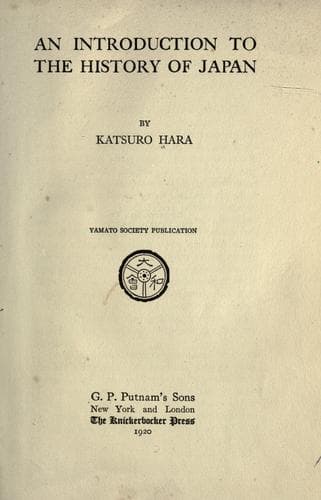
An Introduction to the History of JapanHara, Katsuro
History
An Introduction to the History of Japan
Hara, Katsuro
Japan -- History
The political anarchy combined with the individualistic tendency of the
age could not fail to lead to the moral dissolution of the people. To
the same effect, too, the literature of the time, which was a revival of
that of the Fujiwara period, contributed. The classical authors of
Japanese literature at the height of the Fujiwara period were now
perused, commented upon, and elucidated with devouring eagerness, the
most adored among them being Murasaki-Shikibu, whose famous novel,
_Genji-monogatari_, was regarded mystically and held to be almost
divine. The nature of this literature was for the most part realistic,
or rather sentimental, verging sometimes on sensuality. It was, however,
clad in the exquisitely refined costume of beautiful diction and choice
turns of phrase, borrowed or metamorphosed from the inexhaustible stores
of Chinese literature. As to the revived form of literature in the
Ashikaga period, the difference between it and that of the old time was
so remarkable, that it could not be overlooked. Vulgarisation usurping
the place of refinement, and coarse sensuality reigning rampant was the
outcome of the cultivation of the classical literature. The moral tone
of the stories and novels produced in this decadent age unmistakably
reflects how low was the ebb of the sense of decency of that period,
fostered by the naturalistic tendency manifested in the Fujiwara
classics.
These depict the dark side of the age, but in order not to be one-sided
in my judgment, let me tell also about its bright side. The culture of
the Ashikaga had from the beginning a trend to grow more and more
humanistic as it approached the end of the period. One more aspect in
the history of Japanese painting proves it to the full. Landscapes and
still-life pictures, which had been formerly painted only as the
accessories of religious images or as the background in the scroll
paintings, before which the main subjects, that is to say, the
personages in stories were made to play, began now to form by themselves
each a special independent group of subjects for painting. This shows
that the people of the time had already entered a cultural stage able to
enjoy the arts for art's sake. Many pictures of such a kind by the brush
of noted Chinese masters were imported into our country, and several
clever Japanese artists also painted after them. Some of our artists,
like Sesshu, went over to China to study the art of painting there. The
differentiation of the school of Kano from the older Tosa was another
result of this development. Most of these pictures were executed in the
form of _kakemono_, or hanging pictures, so called from their being
hung in a special niche of a drawing room or a study. Screens, or
_byobu_, mounted with pictures, became also a fashion. In general, the
furnishing of a house was now a matter of a certain educated taste, and
various systems were devised and formulated by accomplished experts.
Public-domain text, read in full here on John Shaqi.
Reviews
Reviews
No reviews yet
Be the first to share your thoughts on this work.
Elsewhere in the archive
Join the Discussion
Join the discussion
Sign in to leave a comment or review.
Sign InorCreate an account