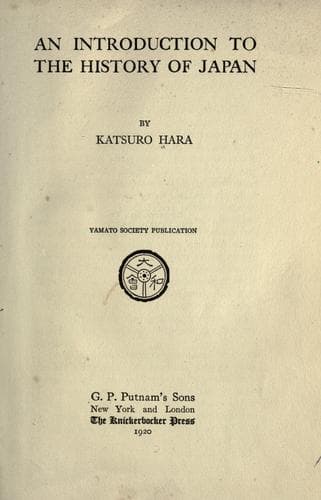
An Introduction to the History of JapanHara, Katsuro
History
An Introduction to the History of Japan
Hara, Katsuro
Japan -- History
The delicacy of the aesthetic sense in indoor-life was moreover enhanced
by the laborious etiquette of fashionable tea-parties held by
aristocrats and bourgeois alike. The tea-plant itself is said to have
been introduced from China into our country in the reign of the Emperor
Saga, that is to say, at the beginning of the ninth century. Its use,
however, as the daily beverage was of a far later date. Yosai, the
founder of the Zen sect in Japan, wrote in the early Kamakura period a
commendation on tea as the healthiest drink of all. Still, for a long
while after him, tea seems to have been used exclusively by Buddhists as
a tonic. It was in the Ashikaga age that tea came first into general use
among the well-to-do classes of the people. As the production of it was,
however, not so abundant as now, it was not used daily as at present,
but occasionally, with an etiquette conducted with exquisitely refined
taste, both hosts and guests rivalling one another in displaying their
artistic acquirements by delivering extempore speeches in criticism of
the various articles of art exhibited, or in amusing themselves with
mystic dialogues of the Zen creed, or the lively exchange of witty
repartees.
After all, the tendency of the culture of the later Ashikaga period was
in the main humanistic. There was no political authority so firmly
constituted, nor were conventional morals of the time so rigorous, as to
be able to put an effective check on any liberal thinker, nor to
intervene in the daily life of the people. Thought and action in Japan
has never been more free than in that age. That Christianity could find
innumerable converts from one end of the empire to the other within half
a century after its introduction, may be accounted for by supposing that
the ground for it had been prepared long before by this exceedingly
humanistic culture. In this respect we see the dawn of modern Japan
already in the later Ashikaga age. What a striking similarity to the
Italian renaissance! Japan was now in the throes of travail--the time
for a new birth was fast approaching. Conditions on the whole were
favourable. All that was wanted for this were the moral regeneration of
the people and the political reconstruction of the Empire.
CHAPTER X
THE TRANSITION FROM MEDIAEVAL TO MODERN JAPAN
Public-domain text, read in full here on John Shaqi.
Reviews
Reviews
No reviews yet
Be the first to share your thoughts on this work.
Elsewhere in the archive
Join the Discussion
Join the discussion
Sign in to leave a comment or review.
Sign InorCreate an account