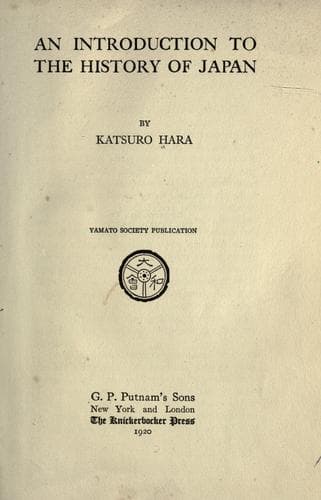
An Introduction to the History of JapanHara, Katsuro
History
An Introduction to the History of Japan
Hara, Katsuro
Japan -- History
Besides this facilitation of the political unity, what most contributed
to the settling of the general order was the resuscitation of the moral
sense of the nation. The highly advanced Chinese civilisation introduced
into our country at a time when it was comparatively naive, had an
effect which could not be termed exactly in all respects wholesome. The
morals of the people, whose mode of life was simplicity itself, not
having yet tasted the sumptuousness of civilised life, excelled those of
higher civilised nations in veracity, soberness, and courage. Lacking,
however, in the firm consciousness which must accompany any virtue of a
standard worthy of sincere admiration, these attributes of the ancient
Japanese, though laudable in themselves, could have no high intrinsic
value, and were inadequate to stem the enervating influence of the
elegantly developed alien civilisation introduced later on into the
country. The ethical ties, which are indispensable at any time for
maintaining the social order in a healthy condition, were gradually
reduced to a state of utter dissolution in the later or over-refined
stage of the Fujiwara period, especially among the upper classes. With
the attainment of political power by the warrior class in the formation
of the Kamakura Shogunate, there shimmered once some hope of the
reawakening of the moral spirit, for fidelity and gratitude, which were
the cardinal virtues of the Kamakura warriors, were efficient factors in
refreshing and invigorating a society which had once fallen into a
despicable languor and demoralisation. The ascendency of these bracing
forces, however, was but transitory. This disappointment came not only
from the shortness of the duration of the genuine military regime at
Kamakura, but also from another reason not less probable. The admirable
virtues of the warriors were the natural outcome of the peculiar private
circumstances created in the fighting bodies of the time, and were on
that account essentially domestic in their nature. As long as these
warriors remained, therefore, mere professional fighters and tools in
the hands of court nobles, the moral ties binding leaders and followers
as well as the _esprit de corps_ among these followers themselves had
very slight chance of coming into contact with politics. In short, the
majority of these warriors were not acquainted with public life at all,
so that they were at a loss how to behave themselves as public men when,
as the real masters of the country, they found themselves obliged to
deal with political affairs. Public affairs are generally prone to
induce men even of high probity to put undue importance upon the
attainment of end, rather than to make them scrupulous about the means
of arriving at that end; and if the moral sense of the people is not
developed enough to guard against this injurious infection of private
life from the meddling with public affairs, then their inborn and yet
Public-domain text, read in full here on John Shaqi.
Reviews
Reviews
No reviews yet
Be the first to share your thoughts on this work.
Elsewhere in the archive
Join the Discussion
Join the discussion
Sign in to leave a comment or review.
Sign InorCreate an account