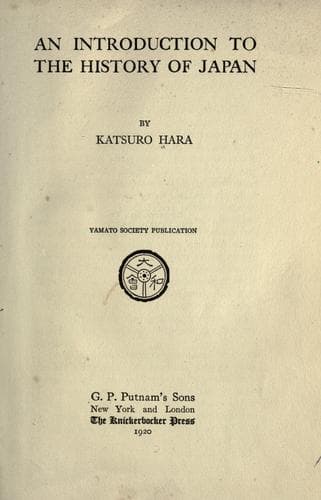
An Introduction to the History of JapanHara, Katsuro
History
An Introduction to the History of Japan
Hara, Katsuro
Japan -- History
untried virtues may often fail to assert themselves against the
influence of the depravity which can find its way more easily into
public than into private life. Such was the case with the warriors of
the Kamakura age. Through their ascendency the martial spirit of the
nation, which had languished somewhat under the rule of the Fujiwara
nobles, was once more revived, but their descendants at the end of that
Shogunate could not be so brave and simple-hearted as their forefathers
were. The extinction of the Minamoto family, too, relieved these
warriors of their duty as hereditary liegemen of the Shogun, for
henceforth both the Shogun, who was now of a different family from that
of the Minamoto, and the Hojo, the real master of the Shogunate, were to
them superiors only in official relations. This disappearance of the
object on which the fidelity of the warriors used to concentrate, made
fidelity itself an empty virtue. At least among the circle of warriors
in the age in which fidelity was everything and all other virtues were
but ancillary to it, this loss must have been a great drawback to the
improvement of the morality of the nation. The demoralisation of the
influential class had thus set in since the latter part of the Kamakura
age. No wonder that during the civil war which ensued many of the
prominent warriors changed sides very frequently, almost without any
hesitation, obeying only the dictates and suggestions of their private
interests. That this civil war, which ended without any decisive battle
being fought, could drag on for nearly a century, may be best understood
by taking this recklessness of the participants into consideration. The
inconsistency in their attitude or the want of fidelity towards those to
whom they ought to be faithful was not restricted to their transactions
in public affairs only, but extended also to the recesses of their
family life. Parents could no more confide in their own children, nor
husband in his wife, and masters had always to be on guard against
betrayal by their servants. After the civil war there were many periods
of intermittent peace in the first half of the Ashikaga regime, but
that was not a result of the firm and strong government of the Shogun.
They were rather lulls after storms, brought about by the weariness felt
after a long anarchy.
Public-domain text, read in full here on John Shaqi.
Reviews
Reviews
No reviews yet
Be the first to share your thoughts on this work.
Elsewhere in the archive
Join the Discussion
Join the discussion
Sign in to leave a comment or review.
Sign InorCreate an account