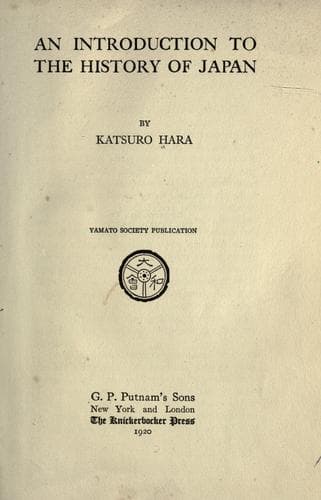
An Introduction to the History of JapanHara, Katsuro
History
An Introduction to the History of Japan
Hara, Katsuro
Japan -- History
The reawakening of the high moral sense in the nation and the formation
of compact self-constituted territories, virtually independent but amply
liable to the influence of unifying forces, were the phenomena in the
latter half of the Ashikaga period. That the country was slow in
becoming nationalised and unified must be attributed to the
insufficiency of that reawakening and the insolidity of those
quasi-independent territories. The general culture of the time, which
was humanistic in nature, was powerless for the moment to facilitate
this movement which was national and moral at the same time. Humanistic
as it was, it was able to pervade the provinces, and gave to Japan a
uniform colour of culture. That was already, indeed, a stride forward on
the way to national unification. Nay, it may be said that the impulse to
that very unification was given by that very culture. Generally,
however, the humanistic culture of any form has no particular state of
things as its practical goal, and therefore cannot necessarily lead to
an improvement in the morals of any particular nation, nor does it
always stimulate the desire for the national unification of a certain
country. On the contrary, it often counteracts these movements, and
seemingly contributes toward accelerating the demoralisation and
dismemberment of a nation, for individualism and selfishness get often
the upper hand when such a culture becomes ascendant. The fruit which
the Renaissance of the Quattrocento bore to Italians was just of this
sort, and the direct influence which the humanistic culture of the later
Ashikaga produced on Japan was not very much different from that. The
culture, which had spread widely all over Japan, rather tended to loosen
moral ties, and at least diminished the social stability. Persons, of a
character morally most depraved, such as traitors, murderers, and so
forth, were not infrequently men of high culture. Most of the rebellious
servants of the Ashikaga Shogun were said to have been
highly-accomplished literati. Some of them were addicted to the perusal
of the sensational novels produced in the golden age of classical
literature in Japan, such as the _Ise-_ and the _Genji-monogatari_, and
others were composers of short poems fashionable in those days,
rejoicing at their own display of flighty wit, while not a few of them
were liberal patronisers of the contemporary art, especially of
painting. What a striking parallelism to those Popes and their nephews,
in the time of the Renaissance, whose patronising of arts is as renowned
as their atrocious vices!
Public-domain text, read in full here on John Shaqi.
Reviews
Reviews
No reviews yet
Be the first to share your thoughts on this work.
Elsewhere in the archive
Join the Discussion
Join the discussion
Sign in to leave a comment or review.
Sign InorCreate an account