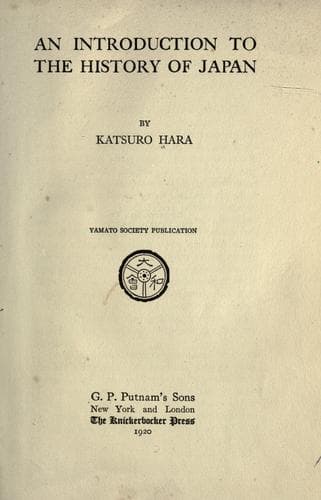
An Introduction to the History of JapanHara, Katsuro
History
An Introduction to the History of Japan
Hara, Katsuro
Japan -- History
If the culture inborn or borrowed from China was unable to save the
country from a moral and political crisis, what was the fruit borne by
the seeds of the new exotic culture, that is to say, of Christianity,
sown just at this juncture? I will not dilate here on the relation
between religion and morality in general. Suffice it to say that
religious people are not always virtuous. Bigots are generally men of
perverse character, and mostly vicious. This is a truism. It has been so
with Buddhism and many other religions. Why should it be otherwise only
in the case of Christianity? As regards the general culture of our
country, the introduction of Christianity is a very important historical
fact, the influence of which can by no means be overlooked. Though the
secular culture which was introduced into Japan as the accessory of the
Christian propaganda was of a very limited nature, and though the free
acceptance of it was cut short soon after its circulation, yet this new
element of civilisation brought over by the missionaries was much more
than a drop in the ocean. However difficult it be to perceive the traces
of the Western culture in the spirit of the age which was to follow, it
cannot be denied that it left, after all, some indelible mark on our
national history. That it had spread within a few decades all over the
contemporary Japan, from the extreme south to the furthest north, should
also not be left out of sight. Thenceforth the Fables of AEsop have not
ceased to be told in the lamplit hours in the nurseries of Japan. We see
Japan, after the first introduction of Christianity, painted in a
somewhat different colour, though the difference of tincture may be
said to be extremely slight. The knowledge at least that there were
outside of China, many people in the far West, civilised enough to teach
us in several branches of science and art, opened the eyes of the island
nation to a wider field of vision, and began to alter the views which we
had entertained about things Chinese. Previously, for anything to become
authoritative, it had been enough if the Chinese origin of that thing
could be assured. The overshadowing influence which China had wielded
over Japan at the time of the Fujiwara regime was revived in different
form in the middle Ashikaga period, the former being China of the T'ang,
while the latter that of the Sung, Yuan, and Ming. In short, China had
long continued as a too brilliant guiding star to the Japanese mind,
Korea, by the way, having been regarded only as one of the
intermediaries between the "flowery" Empire and our country. It would
be, of course, a hasty judgment to conclude that the introduction of
Christianity instantly let the scales fall from the eyes of the Japanese
as regards China, and aroused thereby a fervent national enthusiasm of
the people, but at least it was a strong impetus to the awakening of the
national consciousness, and led indirectly to the political unification
of the country.
Public-domain text, read in full here on John Shaqi.
Reviews
Reviews
No reviews yet
Be the first to share your thoughts on this work.
Elsewhere in the archive
Join the Discussion
Join the discussion
Sign in to leave a comment or review.
Sign InorCreate an account