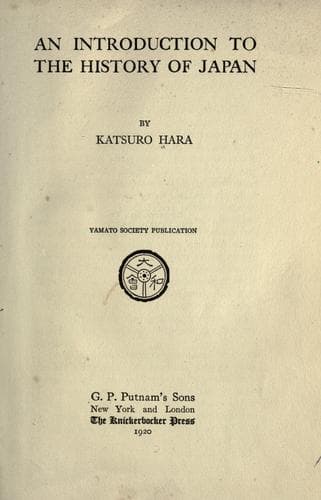
An Introduction to the History of Japan — John Shaqi
An Introduction to the History of JapanHara, Katsuro
History
An Introduction to the History of Japan
Hara, Katsuro
Japan -- History
Feudalism is indeed a necessity, as a Chinese servant has said in a
memorable essay. It is a necessity which any nation must undergo, if
that nation is to become consolidated. Feudalism is often described as a
backward movement with respect to the political organisation. Primitive
races, however, cannot be described as having been either centralised or
decentralised, socially and politically, and the first stage which they
must pass is that of a vague centralisation. In this stage,
superficially observed, it appears as if the race were centralised at
one point, but the truth is that in so early a stage of civilisation, it
is not probable that more than one prominent centre would at once be
formed conspicuous enough to attract attention. And even that one centre
itself is formed, not because it is strong enough to centralise, but
because centripetalism actuates the environment, and no other force is
yet so strong as to compete with it. In early times, however, the degree
of prominency of a single centre over all others must have been very
slight. As time passes, lesser centres begin to distinguish themselves,
closely following the prominent first in strength of centralisation,
and become at last so powerful as to be able to challenge the hegemony
of the first centre. This state of affairs we generally denote as the
age of dismemberment, as if a true centralisation had been accomplished
in the age preceding. This view is utterly false. Without the power to
centralise, no political centre can be said to exist really, and without
any strong centre effective centralisation is not possible. The apparent
centralised, that is to say, unified condition of the ancient empires,
is nothing but a chaotic condition with one bright point only, and the
state of being seemingly dismembered is in truth a step toward the real
unification, centralisation _in partibus_ paving the way for
centralisation on a larger scale. This phase in the preparatory process
for the unity and consolidation of a nation is feudalism itself.
Feudalism is a test through which every nation must pass, if it aspires
to become a well organised body at all. There are some tribes, indeed,
which have never passed through the feudal period in their history, but
that is due to the fact that these tribes had certain defective traits
which hindered them from undergoing that experience, and on account of
that they have been unable to achieve a sound, well-proportioned
progress in their civilisation, which must necessarily be accompanied by
a well-organised political centralisation, whether it be monarchical or
democratic. Other nations have passed, it is true, the test of the
feudal regime, but very imperfectly, and for that reason have had great
difficulty in amending the defect afterwards.
Public-domain text, read in full here on John Shaqi.
Reviews
Reviews
No reviews yet
Be the first to share your thoughts on this work.
Join the Discussion
Join the discussion
Sign in to leave a comment or review.
Sign InorCreate an account