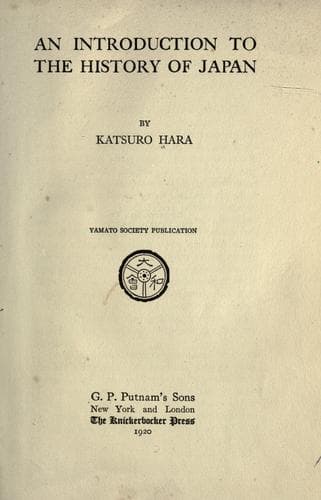
An Introduction to the History of JapanHara, Katsuro
History
An Introduction to the History of Japan
Hara, Katsuro
Japan -- History
Japan was ready to be transformed into a solid national state, and at
the same time to emerge from a chaotic medieval condition to enter the
modern status. The cultural milieu, however, though it might have been
ripe for change, must have found it difficult to get transformed by
itself, and wanted an infusion of some new element to create an
opportunity for the change. A new element did come in, but it proved to
be unable to effect any wholesome alteration, so that in order to create
that opportunity the only possible and promising way was to resort first
to the political unification of the country, and thus to start from the
political and so to reach social and individual regeneration. And for
that political unification the right man was not long wanting. We find
him first in Nobunaga Oda, then in Hideyoshi Toyotomi, and lastly in
Iyeyasu Tokugawa.
The first task was naturally to break down the authority of numerous
traditions and conventions which had kept the nation in fetters for a
long time. This task was an appropriate one for such a hero as Nobunaga,
who was imperious and intrepid enough to brave every difficulty coming
in his way. He was born in a family which had been of the following of
the house of Shiba, one of the branches of the Ashikaga, and had
continued as the hereditary administrator of Owari, a province which
formed part of the domain of its suzerain lord. When the power of the
house of Shiba decayed, the Oda family asserted its virtual independence
in the very province in which it had been the vicegerent of its lord,
and it was after this assertion of independence that our hero was born.
Strictly speaking, therefore, his right as a territorial lord was
founded on an act of usurpation, that is to say, Nobunaga's claim as the
owner of the province had no footing in the old system of the Ashikaga,
so that he was destined by his birth to become a creator of the new age,
and not the upholder of the ancient regime. The province over which he
held sway has been called one of the richest provinces in Japan, and was
not far from Kyoto, which was, as often stated before, still by far the
most influential among the political and cultural centres of the empire.
He and his vassals, therefore, had more opportunities than most of the
territorial lords and their vassals living in remote provinces, of
getting sundry knowledge useful to make his territory greater and
stronger. In the year 1560 he defeated and killed his powerful enemy on
the east, Yoshimoto Imagawa, the lord of the two provinces, Totomi and
Suruga. This was his first acquisition of new territory. Four years
after, the province of Mino, lying to the north of Owari, came into his
possession. In 1568 he marched his army into Kyoto to avenge the death
of the Shogun Yoshiteru, and installed his brother, who was the last of
the Ashikaga line, as the new Shogun. Then one territory after another
was added to his dominion, so that the Shogun was at last eclipsed in
Public-domain text, read in full here on John Shaqi.
Reviews
Reviews
No reviews yet
Be the first to share your thoughts on this work.
Elsewhere in the archive
Join the Discussion
Join the discussion
Sign in to leave a comment or review.
Sign InorCreate an account