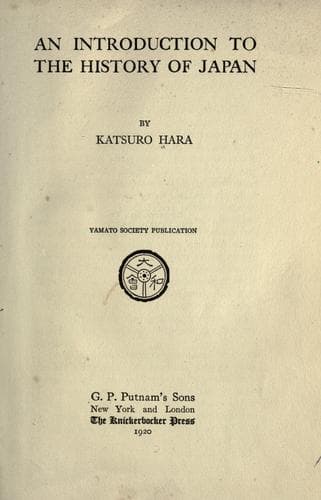
An Introduction to the History of JapanHara, Katsuro
History
An Introduction to the History of Japan
Hara, Katsuro
Japan -- History
power and influence by Oda, without ever having renounced his hereditary
rights. Nobunaga's dominion reached from the Sea of Japan to the Pacific
shore, when he met at the height of his career of conquest a premature
death by the hand of a traitor.
It is not, however, on account of the magnitude of the territories which
he annexed, that Nobunaga figures in the history of Japan, for the land
conquered by dint of his arms did not cover more than one-third of the
island of Honto. His real historical importance lies not there, but in
that he destroyed the old Japan and made himself the harbinger of the
new age, though the honour of being creator of modern Japan must be
assigned rather to Hideyoshi, his successor. Since the beginning of our
history, the Japanese have always been very reluctant, in the cultural
respect, to give up what they have possessed from the first, while they
have been very eager and keen to take in the new exotic elements which
seemed agreeable or useful to them. In other words, the Japanese have
been simultaneously conservative and progressive, and immoderately so in
both ways. The result of such a conservation and assimilation operating
at the same time was that the country has gradually become a depository
of a huge mass of things Japanese and Chinese, no matter whether they
were desirable or not. If any exotic matter or custom once found its way
into this country, it was preserved with tender care and never-relaxing
tenacity, as if it were some treasure found or made at home and would
prove a credit to our country. In this way we could save from
destruction and demolition a great many historical remains, material as
well as spiritual, not only of Japanese but also of Chinese origins.
There may still be found in our country many things, the histories of
which show that they had once their beginnings in China indeed, but the
traces of their origins have long been entirely lost there. Needless to
say that the religious rites and other traditions of our forefathers in
remotest antiquity have been carefully handed down to us. This assiduity
for preserving on the part of the Japanese can best be realised by the
existence to this day of very old wooden buildings, some of which, in
their dates of erection, go back to more than twelve hundred years ago.
Besides this conservative propensity of the nation, the history of our
country has also been very favourable to the effort of preserving. We
have had no chronic change of dynasties as in China, nor have we
experienced any violent revolution, shaking the whole structure of the
country, as the French people had. Though our history has not lacked in
civil wars and political convulsions, their destructive force has been
comparatively feeble, and one Imperial house has continued to reign here
from the mythic Age of the Gods! With this permanent sovereign family as
the _point d'appui_, it has been easier in Japan than in any other
country to preserve things historic.
Public-domain text, read in full here on John Shaqi.
Reviews
Reviews
No reviews yet
Be the first to share your thoughts on this work.
Elsewhere in the archive
Join the Discussion
Join the discussion
Sign in to leave a comment or review.
Sign InorCreate an account