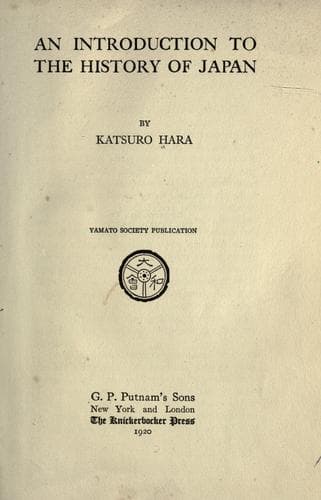
An Introduction to the History of JapanHara, Katsuro
History
An Introduction to the History of Japan
Hara, Katsuro
Japan -- History
Things thus preserved, however,
have not all been worthy of such care. As we have been obliged to march
constantly with hurried steps in our course of civilisation, little time
has been left to us to pause and discriminate what was good for
preservation from what was not. We have betaken ourselves occasionally
to the process of rumination, but it did not render us much assistance.
Not only rubbish has not been rejected, as it should have been, but the
things which proved of good service at one time and subsequently wore
out, have been hoarded over-numerously. Think of this immense quantity
of the slag, the detritus, of the civilisations of various countries in
various ages all dumped into the limited area of our small empire! No
people, however vigorous and progressive they may have been, would have
been able to go on briskly with such a heavy burden on their backs. The
worst evils were to be recognised in the sphere of religious belief and
in the transactions of daily official business. Red tape, home-made and
that of China of all dynasties, taken in haphazard and fastened
together, formed the guiding-lines of the so-called "administrative
business" in the time of the court-nobles' regime. The prestige of these
conventionalities was so powerful that even after the installation of
the Shogunate, that is to say, after the establishment of the government
which really meant to govern, the administration, promising to be far
more effective than that of the Fujiwara's, had to be varnished with
this conventionalism. Kiyomori, the first of the warriors to become the
political head of the country, failed, because he was ignorant of this
red-tapism. The Shogunate initiated by Yoritomo tried at first to keep
itself aloof from this influence, but could succeed only for a short
duration. The second Shogunate, the Ashikaga, had been overrun almost
from its inception by the red tape of the courtiers' regime, as well as
by the routine newly started in Kamakura. The humanistic culture, which
glimmered during the latter part of this Shogunate, was by its nature
able to find its place only where conventionalism did not reign, but it
soon began to give way and be conventionalised also. Until this
red-tapism was destroyed, there could have been no possibility of the
modernisation of Japan.
Public-domain text, read in full here on John Shaqi.
Reviews
Reviews
No reviews yet
Be the first to share your thoughts on this work.
Elsewhere in the archive
Join the Discussion
Join the discussion
Sign in to leave a comment or review.
Sign InorCreate an account