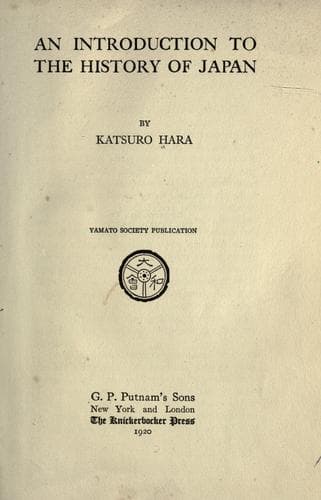
An Introduction to the History of JapanHara, Katsuro
History
An Introduction to the History of Japan
Hara, Katsuro
Japan -- History
Class distinction was another dark spot on the culture of the age. All
sorts of people outside the fighting class were roughly classified into
three bodies, that is to say, peasants, artisans, and merchants, and
were held in utter subjection, as classes made simply to be governed.
But the often-quoted tradition that warriors of that time had as their
privilege the right to kill any of the commonalty at their sweet will
and pleasure, without the risk of incurring the slightest punishment
thereby, is erroneous, having no foundation in real historical fact.
Those warriors who had committed a homicide were without prejudice
called upon to justify their act before the proper authority. If they
failed to prove that they were the provoked and injured party, they were
sure to have severe penalties inflicted on them. On the whole, however,
the common people in the Tokugawa age were looked down upon by warriors
as inferiors in reasoning and understanding, and therefore as
disqualified to participate in public affairs, social as well as
political. That their intellectual defects must have been due to their
neglected education was a matter clean put out of mind. As regards the
respective professions of the above-mentioned three classes of
plebeians, agriculture was thought to be the most honourable, on account
of producing the staple food-material, so that warriors, especially of
the lower classes, did not disdain to engage in tilling the lands
allotted to them or in exploring new arable lands. The peasants
themselves, however, were not so greatly esteemed on account of their
engaging in a profession which was held honourable. Handicrafts in
general and artisans employed in them had not been held particularly
respectable by themselves, but as the profession was productive, it was
recognised as indispensable, despised by no means. Moreover, many
artistic geniuses, who had come out of the innumerable multitudes of
artisans of various trades, have been held in very high regard in our
country, where the people have the reputation of being one of the most
artistic in the world; and those articles of rare talent unwittingly
raised the esteem of the crafts in which they were engaged. That which
was most despised as a profession was the business of merchants in all
lines, for to gain by buying and selling was thought from times past to
be a transaction approaching almost to chicanery, and therefore by no
means to be encouraged from the standpoint of national and martial
morals. Pedlars and small shop-keepers were therefore simply held in
contempt. Great merchants, however, though not much esteemed on account
of their profession, were generally treated with due consideration in
virtue of their amassed wealth. Only too frequently had the Shogunate,
as well as various _daimyo_, been obliged to stoop to court the goodwill
of rich merchants in order to get money from them.
Public-domain text, read in full here on John Shaqi.
Reviews
Reviews
No reviews yet
Be the first to share your thoughts on this work.
Elsewhere in the archive
Join the Discussion
Join the discussion
Sign in to leave a comment or review.
Sign InorCreate an account