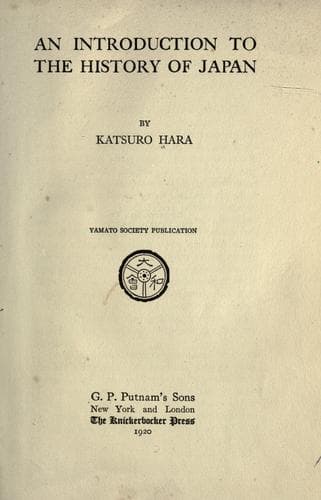
An Introduction to the History of JapanHara, Katsuro
History
An Introduction to the History of Japan
Hara, Katsuro
Japan -- History
The methods of taxation were very arbitrary, and the person and the
rights of property of individuals were not very highly respected at that
time, the common people under the Shogunate being often subjected to
hard and brutal treatment, their persons maltreated and injured and
their properties confiscated on various trifling pretences. Though the
way to petition was not absolutely debarred to them, it was made very
irksome and perilous for plebeians to sue and obtain a hearing for their
manifold complaints. On the other hand, as they were not recognised as a
part of the nation to be necessarily consulted, and as the _vox populi_
was not heeded in the management of public affairs, their education was
not regarded as an indispensable duty of the government. No serious
endeavour had ever been made to improve the common people
intellectually, nor to raise their standard of living. If a number of
them showed themselves able to behave like gentle folk, as if they had
been warriors by birth and, therefore, well-educated, they were rewarded
as men of extraordinary merits such as could not be reasonably expected
of them.
The status of the political organisation of the country during the
Tokugawa regime was also what ought to be called medieval, if we draw
our conclusions from the materials ranged on the darker side only. The
country had been divided into parcels, large and small, numbering in all
a little less than three hundred, each with a territorial lord or a
_daimyo_ as its quasi-independent autocratic ruler. The frontier line
dividing adjacent territories belonging to different _daimyo_ used to be
guarded very vigilantly on both sides, and passage, both in and out, was
minutely scrutinised. For that purpose numerous barrier-gates were set
up along and within the boundary. Any land bounded by such frontiers,
and conferred on a _daimyo_ by the Shogunate as his hereditary
possession, was by its nature a self-constituted state, the political
system prevailing within which having been modelled after that of the
Shogunate itself. At the same time the territory of a _daimyo_ was
economically a self-providing, self-sufficient body. To become in such
wise independent at least was the ideal of the _daimyo_ possessing the
territory or of the territorial statesmen under him. In other words, the
territory of a _daimyo_ was an entity, political and economical. In each
territory certain kinds of produce from those confines had been
strictly prohibited by regulation to be exported beyond the frontier,
for fear that there might sometimes occur a scarcity of those
commodities for the use of the inhabitants of the territory, or lest
other territories should imitate the cultivation of like kinds of
produce, so that the value of their own commodities might decrease
thereby. In case of a famine, that is to say, of the failure of rice
crops in a territory, a phenomenon which has by no means been of rare
Public-domain text, read in full here on John Shaqi.
Reviews
Reviews
No reviews yet
Be the first to share your thoughts on this work.
Elsewhere in the archive
Join the Discussion
Join the discussion
Sign in to leave a comment or review.
Sign InorCreate an account