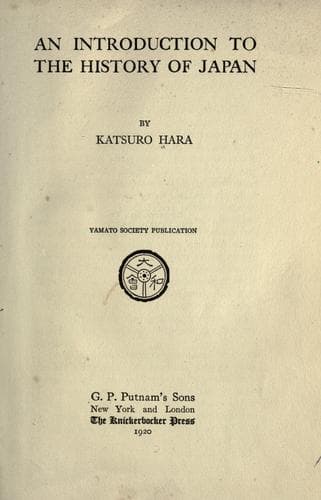
An Introduction to the History of JapanHara, Katsuro
History
An Introduction to the History of Japan
Hara, Katsuro
Japan -- History
In the Shogun's court, a seat was assigned to each _daimyo_ in a
specified room, according to the class to which he belonged. One could,
therefore, easily tell the rank of a _daimyo_ by the name of the room in
which he had to wait when he attended on the Shogun. All _daimyo_,
almost without exception, had to move in and out at fixed intervals
between his territory, where his castle or camp stood, and Yedo, where
he kept, or, to say more correctly, was granted by the Shogun,
residences, generally more than two in number. The interval allowed to a
_daimyo_ for remaining in his territory varied according to the distance
of that territory from Yedo, being the shorter and oftener for the
nearer. He was obliged to leave his wife and children constantly in one
of his residences at Yedo, as hostages for his fidelity to the Shogun.
As to the vassals or _samurai_ of a _daimyo_, there were also two sorts.
By far the greater part of the _samurai_ belonging to a _daimyo_ had
their dwellings in their master's territory, generally in the vicinity
of his castle. These _samurai_ were the main support of their lord, and
had to accompany him by turns in his official tour to Yedo and back. The
rest of the _samurai_ under the same lord, a band which formed the small
minority, lived constantly in Yedo, each family in a compartment of the
accessory buildings surrounding the lord's residence like a colony.
These were as a rule men who were enlisted into the service of a
_daimyo_ more for the sake of making a gallant show at his official and
social functions at Yedo, than for the sake of strengthening his
fighting forces. It was natural that men accustomed to the polished life
of the military capital were thought better qualified to fulfil such
functions than the rustic _samurai_ fresh from his territories who were
good only for fighting and other serious kinds of business. While a
_daimyo_ was absent in his territory, a _samurai_ of his, belonging to
this metropolitan group, was entrusted with the care of his residences
and their occupants in Yedo, and also with the duty of receiving orders
from the Shogunate or of transacting inter-territorial business with
representatives of other _daimyo_ at Yedo. The meetings held by these
representatives of the _daimyo_ were said to be one of the most
fashionable gatherings in Yedo. That the doyen of such functionaries had
a certain prestige over others, was very similar to the usage among the
diplomatic corps in Europe.
Public-domain text, read in full here on John Shaqi.
Reviews
Reviews
No reviews yet
Be the first to share your thoughts on this work.
Elsewhere in the archive
Join the Discussion
Join the discussion
Sign in to leave a comment or review.
Sign InorCreate an account