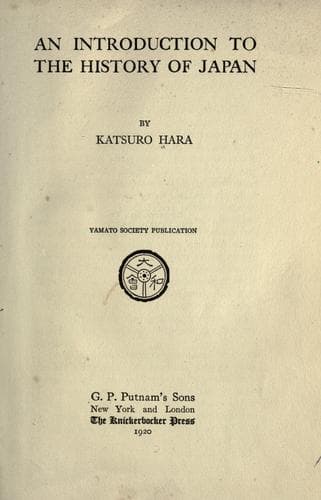
An Introduction to the History of JapanHara, Katsuro
History
An Introduction to the History of Japan
Hara, Katsuro
Japan -- History
rice in any sort of coin then in use, to make a standard of value, not
of the actual amount of rice but of its unceasingly vacillating price,
could not but cause a great deal of inconvenience and confusion. We can
easily see from the above that the quantity of rice was by far the surer
means of bargaining than the money, which was not only indeterminate in
value but insufficient to boot. Hideyoshi, therefore, put a stop to the
use of the method of indicating the income of a territorial lord by its
valuation in money, and decreed that henceforth only the yearly
estimated yield of rice, counted by the _koku_ as a unit, should be
adopted as the means of denoting the revenue of a territory, a _koku_
roughly corresponding to five bushels in English measure. The
land-survey, which he undertook on a grand scale throughout the whole
empire, had as its main purpose to measure the area of land classed as
rice-fields in the territories of the _daimyo_, according to the units
newly decreed, and to make the estimate of the amount of rice said to be
produced commensurate as nearly as possible with the average crop
realisable. Withal, the inequality of the standard of estimate in
different localities was rectified by this assessment of Hideyoshi's.
This method of estimating the income of a _daimyo_ had come into general
use since the beginning of the Tokugawa Shogunate. As there was then no
system in our country of gradating the _daimyo_ by titles, such as
dukes, counts, and so forth, the estimated annual yield of rice in
_koku_ was used as the sole means of determining the rank of the lords
of the various territories in the long queue of the Tokugawa _daimyo_,
with the exception of a very few who had been placed in a comparatively
high rank on account of their specially noble lineage or the unique
position of their families in the national history, though most of the
nobles belonging to the latter class were classed as an intervening
group. The minimum number of _koku_ assigned to a _daimyo_ was ten
thousand. As regards the maximum number of _koku_, there was no legal
limit. One who stood, however, highest in order was the above-mentioned
House of Mayeta, the lord of Kaga etc., whose domain was assessed at
more than a million _koku_. About three hundred _daimyo_, who were
ranged between the two extremes, were divided into three orders. All
those worth more than two hundred thousand _koku_ formed a class of the
_daimyo_ major, and those worth less than one hundred thousand were
comprised in a group of the _daimyo_ minor, while the rest, that is to
say, those between one and two hundred thousand formed the middle corps.
Public-domain text, read in full here on John Shaqi.
Reviews
Reviews
No reviews yet
Be the first to share your thoughts on this work.
Elsewhere in the archive
Join the Discussion
Join the discussion
Sign in to leave a comment or review.
Sign InorCreate an account