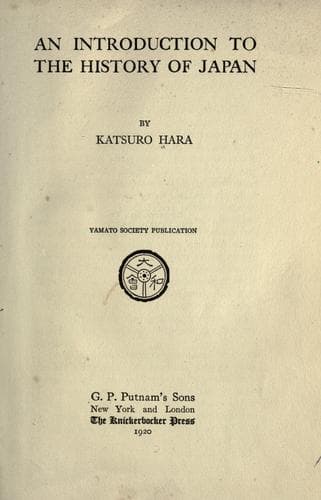
An Introduction to the History of JapanHara, Katsuro
History
An Introduction to the History of Japan
Hara, Katsuro
Japan -- History
The relation of the Shogunate to the Emperor at Kyoto was on the whole
but a continuation of the same status as in the time of Hideyoshi. Since
the Fujiwara period state affairs had ceased to be conducted personally
by the Emperor himself. The regent, who was at first, and ought to have
been ever after, appointed during the minority or the illness of an
Emperor, became identical with the highest ministerial post, and lost
its extra-ordinary character. It is true that some of the able emperors,
dissatisfied with such a state of things, tried to take the reins of
government into their own hands again, and some succeeded for a while in
the recovery of their political power, so far as their relations with
the Fujiwara family were concerned. What they could recover, however,
was not all of the prestige which had slipped out of the hands of their
predecessors. For on account of the lassitude of the Fujiwara
court-nobles, the power which they had once arrogated to themselves
passed into the possession of the newly arisen warrior class, and what
those emperors could recover was only a part of what still remained in
the hands of the Fujiwara. The Emperor Go-Daigo was the last who tried
desperately to resume the imperial prerogative once wrested from the
Kamakura Shogunate, and he succeeded in his endeavour. He could not,
however, prevent the advent to power of the new Shogunate of the
Ashikaga. After that, through the most turbulent age in the history of
Japan, which continued to the time of Hideyoshi, the imperial household
could sustain itself only meagrely on the scanty income from a few
estates. But however lacking in power and material resource the Emperor
might have been, he still continued to be the source and fountain of
honour as ever, and everybody clearly knew that he was, being held
divine, indisputably higher than the Shogun, who was obliged to obey if
the Emperor chose to command. What was to be regretted was that no
Emperor had been strong enough to command. The saying "le roi regne,
mais il ne gouverne pas" has never been accepted in our country as the
constitutional principle. That the imperial prestige was never totally
lost even in the depths of the turmoil of war may be proved by the fact
that the Emperor often interceded in struggles between various _daimyo_,
who waged weary and acrimonious wars against one another. The political
situation of the Emperor, however, had been unsettled for a long while,
only because the situation had remained for long not urgent enough to
require to be made instantly clear. If it had had to be solved at once,
without doubt it must have been solved in favour of the Emperor.
Especially after the civil war of the Ohnin era, to restore the nominal
power, of which the Shogun of the Ashikaga family was in possession,
would have added nothing substantial to the real power of the then
Emperor, for the Shogunate of that time was but a scapegoat in the hands
of impudent and adventurous warriors.
Public-domain text, read in full here on John Shaqi.
Reviews
Reviews
No reviews yet
Be the first to share your thoughts on this work.
Elsewhere in the archive
Join the Discussion
Join the discussion
Sign in to leave a comment or review.
Sign InorCreate an account