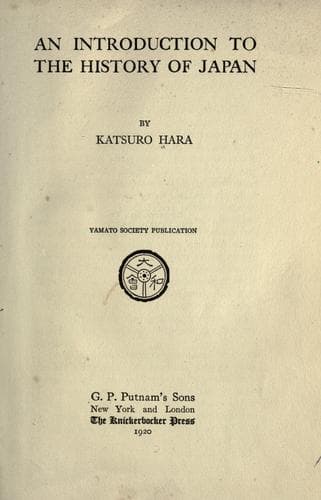
An Introduction to the History of JapanHara, Katsuro
History
An Introduction to the History of Japan
Hara, Katsuro
Japan -- History
The lowest in the scale of the military regime was the group of
_ashigaru_, that is to say, of the light infantry. Those who belonged to
this group, though wearers of two swords, were not counted as of the
corps of _samurai_. Being legally vassals of a _daimyo_, they had yet
very rare chances of serving him directly, and often they enlisted into
the household service of a higher _samurai_. Between the _ashigaru_ and
the regular _samurai_, there was another intermediate group of
two-sworded men, called _kachi_, which means warriors-on-foot. In feudal
times all warriors, if of _samurai_ rank, were presumed to be cavaliers,
though in reality most of them had not even a stable, and skill in
horsemanship was not rigorously required from the _samurai_ of the lower
class. The name _kachi_, given to those who in rank came next to the
_samurai_, implied that this intermediate group of quasi-_samurai_ was
not allowed to ride on horse-back. This group was, however, much nearer
to the _samurai_ than to the _ashigaru_ group.
So far I have given a rough sketch of the gradations in the military
regime in the territory of a _daimyo_. It should be here noticed that,
besides the classes above stated, there were many other minor groups
below the regular _samurai_, and that there were also diverse
heterogeneities of system in the territories of different _daimyo_.
Needless to say that the gradations and kinds of _hatamoto_, who were
_samurai_ serving directly under the Shogun, were far more multifarious
and complex than those of the _samurai_ under a _daimyo_. There is no
doubt, however, that the apex of the whole military regime was the
Shogun himself, while at its foundation were the sundry _samurai_ who
numbered perhaps nearly half a million families in all.
All the lands of Japan were not allotted exhaustively to the _daimyo_ by
the Shogunate. On the contrary, immense territories in various parts of
the empire, amounting to four millions of _koku_, were reserved to the
Shogun himself. Important sea-ports, such as Nagasaki, Sakai, and
Niigata, rich mines like those in the province of Iwami and in the
island of Sado, the vast forest of Kiso in the province of Shinano, and
so forth, were kept in the hands of the Shogunate, out of economical as
well as political reasons. With the income from all these agricultural
and industrial resources, the Shogunate defrayed all the governmental
charges and the expenses of national defence, as well as the enormous
civil list of the Shogun himself, who maintained a very luxurious court.
The stipend for the lower class of _hatamoto_, who had no land allotted
to them, was paid also with the rice raised in the Shogun's domain or
bought with his money and stored in Yedo. As to the fiscal system and
the direct domain of a _daimyo_ in his territory, it is needless to say
that everywhere the imitation of that of the Shogun prevailed, conducted
only on a smaller scale.
Public-domain text, read in full here on John Shaqi.
Reviews
Reviews
No reviews yet
Be the first to share your thoughts on this work.
Elsewhere in the archive
Join the Discussion
Join the discussion
Sign in to leave a comment or review.
Sign InorCreate an account