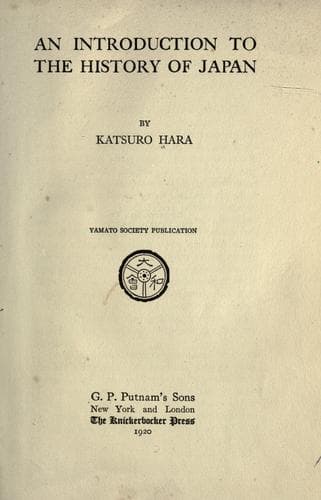
An Introduction to the History of JapanHara, Katsuro
History
An Introduction to the History of Japan
Hara, Katsuro
Japan -- History
By the establishment of the Tokugawa Shogunate, no marked change
occurred in the Emperor's position as supreme sovereign of the country
as ever, but the Shogunate conducted the state business as the regent
entrusted with the whole care of the island Empire, so that the
government at Yedo had no occasion to refer to the court at Kyoto to
obtain the imperial sanction. In this respect the Shogunate of Yedo was
decidedly more independent of the Imperial Court than had been the
Kamakura Shogunate. Kyoto, however, continued as before to be the
fountainhead of all honour. All the honours and titles of the _daimyo_
were conferred in the name of the reigning Emperor, though through the
intermediary of the Shogunate. The appellations of these distinctions
were also the same as those given to court-nobles, only being
comparatively low in the case of the former, if we take the real
influence of the _daimyo_ into consideration. For the emoluments of
court-nobles in the time of the Tokugawa were generally very small, and
the highest of them could only match materially with the middle class of
the _hatamoto_ or the high class vassals of some powerful _daimyo_. All
the manorial estates which the court-nobles had retained until the
middle of the Ashikaga period had since been occupied by warriors
paramount in the respective regions, and they changed their master
several times during the anarchical disorders at the end of the period,
so that restitution became utterly impossible. The total amount which
the Shogunate at Yedo had to pay to the court-nobles as annual honoraria
was about eighty thousand _koku_.
The Imperial Household had a civil list amounting at first to one
hundred thousand _koku_, which was more than three times what it had
been at the time of the Ashikaga. A little later it was increased to
three hundred thousand _koku_, and the sum remained stationary at that
figure for more than half a century. Then an annual subsidy in cash
between thirty and forty thousand _ryo_ was added. The Empress had to be
provided for separately. When there was an ex-Emperor or Crown Prince,
then he also was entitled to a separate allowance from Yedo. If we
include, therefore, the emolument paid to the court-nobles, and estimate
them all together by the number of _koku_, the Shogunate had to pay to
Kyoto an annual sum of between four and five hundred thousand.
Extraordinary expenditures, such as the rebuilding of the imperial
palace, were also part of the burden of the Shogunate. On the whole, the
financial condition of the court at Kyoto was somewhat more straitened
than that of the most powerful _daimyo_.
Public-domain text, read in full here on John Shaqi.
Reviews
Reviews
No reviews yet
Be the first to share your thoughts on this work.
Elsewhere in the archive
Join the Discussion
Join the discussion
Sign in to leave a comment or review.
Sign InorCreate an account