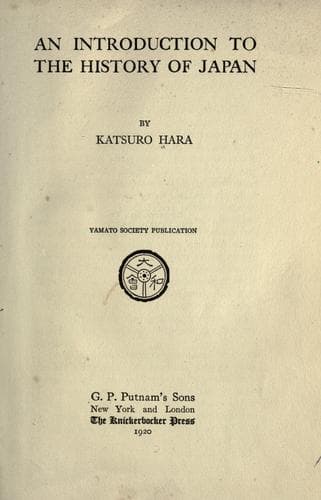
An Introduction to the History of JapanHara, Katsuro
History
An Introduction to the History of Japan
Hara, Katsuro
Japan -- History
With his income as stated the Emperor maintained his court, and
performed historical ceremonies, each prescribed for a certain day of a
certain season. He did not need to trouble himself about state affairs,
for all such matters had been delegated _de facto_ to the Shogunate, or
rather the Shogun behaved himself as if he were the sole agent of the
Emperor. To have direct communication with the Emperor had been
forbidden to all _daimyo_. The Shogun, on his part, entrusted everything
concerning local affairs to the _daimyo_. As to the judicial procedure,
that of the Shogunate was taken as the model by all _daimyo_. There
still prevailed a great many peculiarities in each particular territory
in the ways of legislation and its enforcement, so that Japan of that
time presented a most motley aspect as regards legal matters, like
France under the ancient regime. The power of the _daimyo_ to impose
taxes and raise contributions was restricted by no explicit law, and
therefore had been exercised rather arbitrarily. When in financial
stress, he could freely make applications, approaching to commands, to
some of his well-to-do subjects, whatever the cause of his pecuniary
embarrassment might be. Besides he could coin money, if its use were
limited to his own territory. No need to say that notes were also
abundantly issued by his treasurer for circulation within his territory
as substitutes for the legal tender. In time of peace the _samurai_
under a _daimyo_ served their lord in his territorial government as
civil officials. They, however, being warriors by nature, had to be
constantly trained in military arts, with various weapons, among which
swords and spears were preferred as the most practical. Archery had not
been abandoned entirely, and the bow and arrow was still held to be the
emblem of the noble calling of warriors, but this sort of weapon had
never been used on battle-fields since the beginning of the Tokugawa
period, so that the art had become on the whole ceremonial. The use of
fire-arms introduced at the end of the Ashikaga epoch became rapidly
general all over the country. Gunners were employed, as archers formerly
had been, in opening a battle, and then made way for the attack of the
infantry. Shooting was considered in the Tokugawa period to be more
practical than archery, but as there was little space for showing
personal bravery in the practice of this art, It was not highly
encouraged among the _samurai_. Though fighting on horseback had not
been prevalent on the battle-field since the middle Ashikaga, commanders
at least continued to ride, so that horsemanship was a requisite art of
the _samurai_ in the Tokugawa age, especially among its higher grades.
It should be here well noticed the _jujutsu_, which is now very
celebrated all over the world as a military art originated and
cultivated by the Japanese, did not much attract the attention of the
orthodox Tokugawa warriors, for it was thought to be an art useful in
Public-domain text, read in full here on John Shaqi.
Reviews
Reviews
No reviews yet
Be the first to share your thoughts on this work.
Elsewhere in the archive
Join the Discussion
Join the discussion
Sign in to leave a comment or review.
Sign InorCreate an account