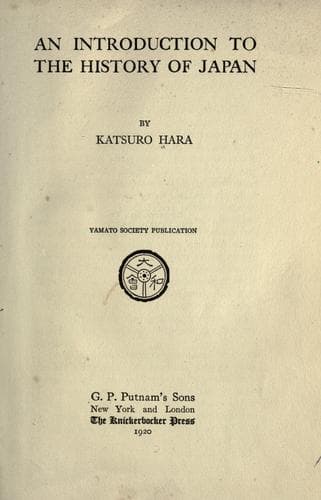
An Introduction to the History of JapanHara, Katsuro
History
An Introduction to the History of Japan
Hara, Katsuro
Japan -- History
For such a continual progress Japan was quite ready. Within half a
century, our country had been transformed from an anarchical country of
interminable wars to a peaceful land, a land which was non-militaristic
to the utmost, though under one of the most elaborate military regimes.
That it had been "shut up" against foreign intercourse was, in its main
motive, not to ward off the infiltration of Western civilisation in
general, but only to achieve a peaceful national progress undisturbed by
any intervention of scheming foreign missionaries. The Shogun, who ought
to have continued as a military dictator, had been turned into a
potentate who cared the least for military matters, though here lurked
the danger of losing his _raison d'etre_ against the Emperor at Kyoto.
The "wisest fool" in Japan was Tsunayoshi, the fifth Shogun of the
Tokugawa, who not only founded a college and a shrine for the spirit of
Confucius at Yushima in Yedo, the site where now the Educational Museum
stands, but was very fond of playing the savant, and himself delivered
lectures commenting on Confucian texts before the assembled _daimyo_ in
duty bound to listen to him. With a Shogun like him at the head of the
government, it should by no means be wondered at that the cultivation of
Chinese literature, which formed the greater part of the learning of the
time, came into vogue among all of those belonging to the military
regime, the _daimyo_ and the _samurai_ of various sorts and grades.
Moreover, the _samurai_ of the age themselves, though they professed to
be warriors as ever in their essential character, and their training in
military exercises had never really significantly relaxed, had ceased to
be fighting men by profession as of yore, on account of the
long-continued tranquillity. Notwithstanding the fact that the reason
they had been honoured and respected by the common people was mainly
because they were serving the country through their master, the
_daimyo_, at the possible hazard of their lives, they had been obliged
gradually not to rely on their martial valour only, but to mould their
character and improve their ability, so as to befit themselves to become
capable officials, administrators, nay, even statesmen in their own
territory and well-bred gentlemen in private life, so as to furnish
models to the common people by their personal examples. As they had read
Chinese works mainly for this purpose, the kinds of books read were
naturally limited, the most preferred being those pertaining to morals
and politics, that is to say, Confucian literature and the histories of
various Chinese dynasties, all of which were pragmatic enough. Their
literary culture, therefore, tended to become rigid, narrow, and
utilitarian, though very serious in intention. At first sight it must
seem a very paradoxical matter that the learning which had been
essentially humanistic in the Ashikaga period should have taken so
utilitarian a tendency in the age directly following it.
Public-domain text, read in full here on John Shaqi.
Reviews
Reviews
No reviews yet
Be the first to share your thoughts on this work.
Elsewhere in the archive
Join the Discussion
Join the discussion
Sign in to leave a comment or review.
Sign InorCreate an account