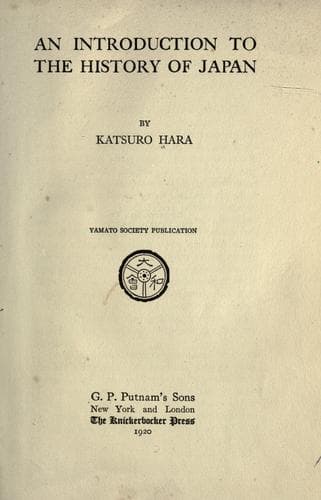
An Introduction to the History of JapanHara, Katsuro
History
An Introduction to the History of Japan
Hara, Katsuro
Japan -- History
If we, however,
once think of the Italian Renaissance metamorphosed into the German
Reformation, when it got northward over the Alps, we need not be much
embarrassed to understand the seemingly abrupt transition in our
country.
It should also be noted that utilitarian studies had not formed the
whole of the literary culture of the Tokugawa age. Since the very
beginning of the Shogunate down to its fall the humanistic studies
handed down by the preceding age had never been entirely swept away from
the land. The utilitarian studies above cited had been almost
exclusively pursued by those _samurai_ standing directly under the
Shogun or under the powerful _daimyo_ whose territories were big enough
to be administered as quasi-independent states, and whose governments
were on such a scale as to need high statesmanship in order to be well
managed. In other words, those who had devoted themselves to the study
of the serious sorts of literature had been generally men to whom some
opportunities might have been given for allowing them to put into
practice what they had learned from books. If these larger territories
were to be compared with Prussia and other kingdoms and middle states in
the German Confederation, the small states in the same political body
would make good counterparts of the petty territories of minor _daimyo_
in Japan. As to those _samurai_ serving the minor _daimyo_, it had been
difficult to make them interested in the perusal of Chinese political
works, for their sphere of action was not wide enough to require the
territorial affairs being conducted according to high and delicate
policies emanating from a profound political principle. In this respect
they had much in common with their colleagues residing in the domains
directly belonging to the Shogunate. As the governor-in-chief and his
principal assistants in each domain had not been taken from the
residents of each district, but despatched thither from Yedo, the
_samurai_ attached to the locality were merely employed to serve the
government of their own district as low-class officials, so that they
had little or no hand even in local politics. Some of these _samurai_
were landed proprietors, who, being rich and having little serious
business to demand their attention, had ample means and time to dip into
books, which could hardly have been of the kind causing self-constraint,
for their first motive in reading was only for the sake of distraction.
The landed gentry, under the _samurai_ in rank, though wealthier, and
generally in charge of village affairs and in control of lesser farmers
and peasants, were also found numerously in the domains. They too were
the sort of people to be classified in the same category as the
_samurai_ of the domains. The _samurai_ and gentry gathered in and
around second-rate towns in large territories belonging to powerful
_daimyo_ may be included also in the same group. It may be, however,
Public-domain text, read in full here on John Shaqi.
Reviews
Reviews
No reviews yet
Be the first to share your thoughts on this work.
Elsewhere in the archive
Join the Discussion
Join the discussion
Sign in to leave a comment or review.
Sign InorCreate an account