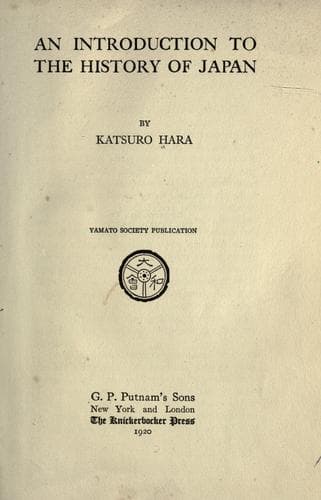
An Introduction to the History of JapanHara, Katsuro
History
An Introduction to the History of Japan
Hara, Katsuro
Japan -- History
Besides these two distinct cultural circles, there arose a third group
of people, who entered the cultured arena in the latter half of the
seventeenth century. I mean the bourgeois class in several large cities.
After the decline of the trade of the historic city of Sakai, brought
about by the hard blow struck at the root of the political power of her
haughty merchants by Nobunaga, and caused also by the growth of a rival
in the great commercial city of Osaka founded by Hideyoshi quite near
it, the refined humanistic culture cherished by the citizens of Sakai
vanished with its prosperity. After that, it took a considerable while
to witness the revival of the cultural influence of the bourgeois class
in Japan. The tranquillity, however, which the Tokugawa Shogunate had
brought on our country, did not fail to cause such a revival, though not
again in Sakai, yet at least in the two greatest commercial centres of
the empire. The one was Yedo on the east, and the other Osaka on the
west. Of these two cities, in affluence Osaka, on account of its
geographical advantages, was several steps ahead of Yedo. Not only was
it near Kyoto, the centre of the humanistic culture as ever, but its
remoteness from Yedo had induced its merchants to become more
independent than those in the Shogun's own city of the influence of the
strong military regime. The culture fostered in the city, therefore, was
nearer to that of the non-military circles than that of Yedo. Nay, Osaka
went still further, even by a great many steps, than Yedo. It was here
that Monzayemon Chikamatsu, the first and the greatest dramatist Japan
has ever produced, demonstrated his peerless talent at the end of the
seventeenth century, and here was also one of the cradles of the modern
Japanese theatre. Yedo, however, could not remain long alien to this
fresh cultural current initiated in Kyoto and Osaka. On account of its
growing prosperity brought on by the constant comings in and out of
hundreds of _daimyo_ and their numerous retinues, the newly started
political capital was soon enabled to rival the senior city of Osaka in
the liveliness of its urban social life, and in some respects surpassed
that of Kyoto. The plutocrats of Osaka had also a very close relation
with the military regime. This relation, however, consisted in lending
large sums of money to various _daimyo_, many of whom had their
warehouses there to deposit therein the produce of their territory, used
as pledges for getting advances of money from those merchants, and on
that account their pay-masters with their staffs were stationed there to
enable them to transact the customary financial business. On the other
hand, the merchants of Yedo generally profited by providing, as
purveyors and contractors, necessary commodities to the Shogunate and to
the _daimyo_, and therefore depended more closely on the military
regime, though some of them also advanced money as did the merchants of
Osaka.
Public-domain text, read in full here on John Shaqi.
Reviews
Reviews
No reviews yet
Be the first to share your thoughts on this work.
Elsewhere in the archive
Join the Discussion
Join the discussion
Sign in to leave a comment or review.
Sign InorCreate an account