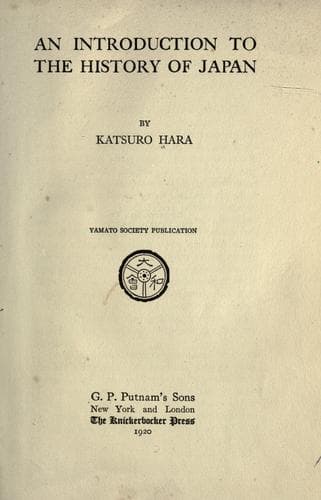
An Introduction to the History of JapanHara, Katsuro
History
An Introduction to the History of Japan
Hara, Katsuro
Japan -- History
premature to suppose that only books belonging to light literature were
welcomed by those who resided in districts where the military regime had
the least hold. Serious works, such as ethical treatises, for instance,
which abound in Chinese literature, were also read there, but rather for
the purpose of occupying themselves with metaphysical speculations about
moral questions, than in order to regulate their own conduct, private
or public, according to the principles taught in them. In short, their
thirst for knowledge was purely for the sake of enjoying an intellectual
pleasure thereby, and therefore had been quite humanistic. It was here
that the true inheritors of the culture of the later Ashikaga were to be
sought, and not in places where the influence of the regular _samurai_
was paramount. Needless to say, the centre of this humanistic culture
was Kyoto, whose significance as the political capital had already been
lost, while Yedo represented at its best the culture of the _samurai_.
The Chinese books preferred by these humanistic dilettanti were those
pertaining to rhetoric and poetry. They were greatly addicted to
practising these branches of literature. Art for art's sake also found a
better patron among such people than in the courts of the Shogun and of
influential _daimyo_, where art had rather an applied meaning,
represented in ornamental things such as screen and wall paintings down
to the miniature-art of the _tsuba_ and the _netsuke_. Wandering poets,
rhetoricians, calligraphers, and artists of various crafts were wont to
be far better harboured in districts where the humanistic culture
prevailed, than in Yedo or in the residential towns of powerful
_daimyo_, where politics and discipline were all-important. The most
significant difference between the two sorts of culture was manifested
in a special branch of art, that of painting. In the military circles,
the painting of the Kano school was preferred, which was rather rigid
in style and had some tincture of the taste highly prized by the
Zen-sect priests. On the other hand, what was in vogue among the
non-military circles was the so-called "Bunjin-gwa," or paintings of the
school of "literati-painters," which were introduced at the beginning of
the Tokugawa period from China, and were characterised by the mellowness
of tone prevailing in them and also by a lack of the professional
flavour.
Public-domain text, read in full here on John Shaqi.
Reviews
Reviews
No reviews yet
Be the first to share your thoughts on this work.
Elsewhere in the archive
Join the Discussion
Join the discussion
Sign in to leave a comment or review.
Sign InorCreate an account