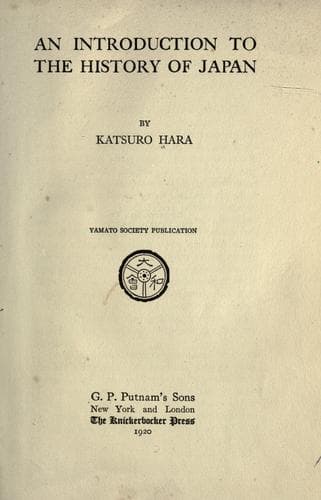
An Introduction to the History of JapanHara, Katsuro
History
An Introduction to the History of Japan
Hara, Katsuro
Japan -- History
Yet the commodities which these Dutchmen brought
to Deshima to be exchanged there or to be presented to the Shogun at
Yedo, gave the Japanese who came in contact with them some idea about
the modes of life in Europe. Moreover, after the encouragement
assiduously given to the study of things European by the Shogun
Yoshimune, whose rule covered the greater part of the first half of the
eighteenth century, the process of infiltration of Western culture
through the narrow door of Nagasaki had become suddenly accelerated. As
the encouragement had been induced by the material necessities of the
nation, the study of that time about things European was naturally
limited to those sciences which were indispensable to the daily life of
the people and at the same time far from being spiritual, like
astronomy, medicine, botany, and so forth. Would it be possible,
however, to ward off successfully the spiritual side of a culture, while
taking in the material side of the same with avidity, as if the two
parts had not been interwoven inseparably as a single entity? Those
branches of Western knowledge, which we did not welcome in the least,
but which were none the less useful, as history, and political as well
as military sciences became gradually known to the Japanese, though very
fragmentarily and slowly. That the diplomatists of the Shogunate had
been able to conclude with the foreign powers, which forced our doors to
be opened to them against our will, treaties which, though evidently
detrimental to our national honour, were the largest concessions we
could obtain from them at that time, shows that they had not been
entirely ignorant of the condition of the parties with which they had
to treat.
Probably there are foreign readers who may entertain some doubt about
the lack of the religious element in the Western civilisation which thus
flowed into our country from the first half of the eighteenth century.
They may well consider, however, the change of religious temperament
both in Japan and in European countries, besides the strictest
prohibition rigorously exercised by the Japanese authorities. The Thirty
Years War, the beginning of which falls in the fourteenth year of the
Shogunate of Hidetada, the son and successor of Iyeyasu, is said
generally to be the last religious war in Europe fought seriously. But
it cannot be denied that in the latter part of the long war, more
political than religious elements predominated, and the age which
followed the most desolatory war was characterised by its religious
toleration. Could the Dutchmen, who were the only people privileged to
trade with us, have been expected to set as their first aim the
propagation of the Christianity of their Reformed Church rather than
material gain by their commerce, as the Portuguese, Spaniards, and
Italians are said to have done as regards their Catholicism at the end
of the Ashikaga period?
Public-domain text, read in full here on John Shaqi.
Reviews
Reviews
No reviews yet
Be the first to share your thoughts on this work.
Elsewhere in the archive
Join the Discussion
Join the discussion
Sign in to leave a comment or review.
Sign InorCreate an account