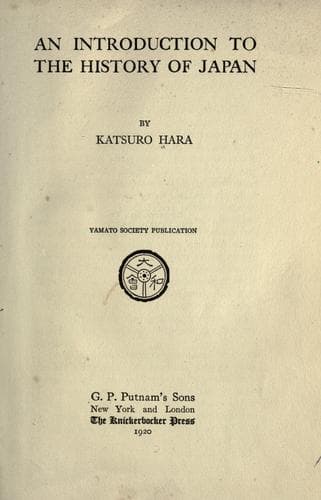
An Introduction to the History of JapanHara, Katsuro
History
An Introduction to the History of Japan
Hara, Katsuro
Japan -- History
Japan had also changed religiously in the same direction. The end of the
Ashikaga period had witnessed many wars which may be called religious,
very rare examples since the time of the first introduction of
Buddhism. Sectarians of Shinshu or Ikkoshu and of Nichirenshu often
fought against one another. Some of them dared also to fight against
powerful feudatories, and harassed them. Thus Japan was about to
experience a struggle between the spiritual and the temporal powers, as
Europe did in the Middle Ages. Nobunaga, therefore, gave countenance to
Christian missionaries with a view to curbing the arrogance of Buddhist
sectaries by the inroad of the new exotic religion. When the latter,
however, proved not less dangerous to the political authority, it was
interdicted by Hideyoshi. After all, the persecution of the Christians
in Japan was not of religious nature, as in Europe, but essentially
political. This explains why persecution could extirpate the seeds of
Christianity sown so full of hope in Japan, in spite of its general
failure in European countries.
The failure of the Christian propaganda, however, was at the same time
the signal of the downfall of the influence of Buddhist sectaries in
Japan. Iyeyasu, who had the most bitter experience of the resistance of
Ikko-votaries in his own province, had but to pursue the same religious
policy as his predecessor, against Buddhism as well as Christianity. He
ordered the personal morals of Buddhist priests to be rigorously
supervised, and inflicted the severest punishment on those who violated
the law of celibacy. It was natural, therefore, that secular preachers
of the Ikkoshu or Shinshu, who made it their rule to lead a matrimonial
life, should not have been held in so high a regard as the regular
priests of other Buddhist sects, and on that account they had to recruit
their believers chiefly among people in the lower strata of society. As
to other sects besides the Shinshu, he showed no preference for any one
of them, and he often called himself a believer in Buddhism of the Syaka
Sect, which meant that he was no sectarian, for there actually existed
no such sect in Japan. Such a broad tolerance, however, in religious
matters is next door to indifferentism, and paved the way for the
dwindling of the religious spirit in the ages to follow, at least in the
prominent part of the nation.
Public-domain text, read in full here on John Shaqi.
Reviews
Reviews
No reviews yet
Be the first to share your thoughts on this work.
Elsewhere in the archive
Join the Discussion
Join the discussion
Sign in to leave a comment or review.
Sign InorCreate an account