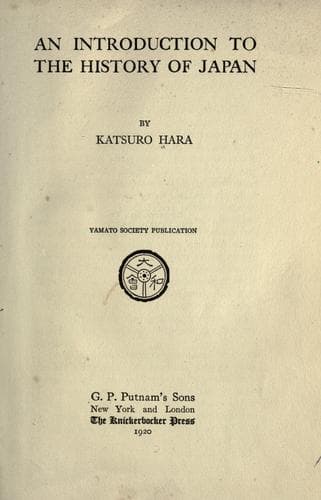
An Introduction to the History of JapanHara, Katsuro
History
An Introduction to the History of Japan
Hara, Katsuro
Japan -- History
Japan by Japanese, a study the inauguration of which almost corresponded
in time with the establishment of durable peace by the Tokugawa
Shogunate. A succession of savants followed in his wake, and the most
noted among them were Mabuchi Kamo and his disciple Norinaga Motooeri. It
was the latter of the two who brought the study of Japanese antiquities
to its highest point in the Tokugawa age.
The time of Motooeri covers the whole of the latter half of the
eighteenth century, for he was born in 1730 and died in 1801 in the
province of Ise. Before him the scope of researches into old Japan had
been limited to the literary products of our ancient poets and
novelists. Though the _Nihongi_ had been talked of by the scholars of
the Ashikaga period and an edition reprinted before the advent of the
house of Tokugawa, that part of the work which had been most widely read
and commented on was its first volume, treating about the age of the
gods and the mythical beginning of the Empire. In other words, the book
had been prized not as an important historical work, but as a sacred
book of Shintoism. It was Motooeri himself who first studied ancient
Japan, not only from the Shintoistic point of view, but also
philologically and historically. Classical literature, which became the
object of his indefatigable research, was not restricted to books of
mythology, but included also the ritual book of "norito," several
collections of poems, and historical works. First of all, however, he
concentrated his efforts upon the study of the old chronicle, _Kojiki_.
He was of the opinion that the _Kojiki_ was more reliable as a
historical source than the _Nihongi_, as it might, according to him, be
easily judged from its archaic phraseology and syntax, in contrast to
the latter, the historical veracity of which must have been surely
impaired by its adoption of the Chinese rhetoric. He made the most
minute, critical study of the text of the _Kojiki_, phrase by phrase,
and word by word. The famous _Kojiki-den_, or "The Commentaries on the
_Kojiki_," is the choicest fruit of his life-long study. In it the
history, religion, manners, customs, in short, all the items concerning
the civilisation of ancient Japan are expounded from the text of the
chronicle itself, frequently corroborated by what is stated in other
authentic sources. He had always in view, and laid great stress on the
fact, that Japan had possessed from her beginning what was to be called
her own, purely and entirely Japanese, quite apart from the culture
which she introduced afterwards from abroad. It was to this unique and
naive state of things in primeval Japan taken as a whole that he applied
the term Shintoism. According to him, therefore, naturalness, purity and
veracity were the cardinal virtues to be taught in Shintoism, from which
he thought not only Indian, but Chinese elements also should be
eradicated. Thus Shintoism was stripped of its religious apparel, with
Public-domain text, read in full here on John Shaqi.
Reviews
Reviews
No reviews yet
Be the first to share your thoughts on this work.
Elsewhere in the archive
Join the Discussion
Join the discussion
Sign in to leave a comment or review.
Sign InorCreate an account