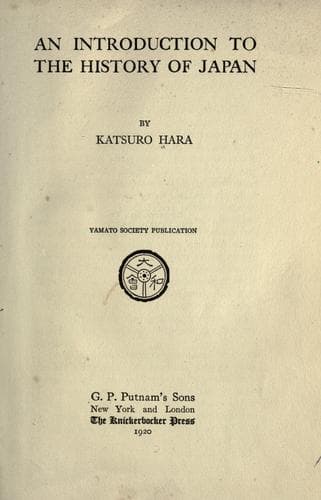
An Introduction to the History of JapanHara, Katsuro
History
An Introduction to the History of Japan
Hara, Katsuro
Japan -- History
which it had been invested during the long course of our history, and by
his endeavours it approached again its original status as a simple moral
cult with primitive rituals; but at the same time it gained immensely in
strength, for it now found its main support in the nationality deeply
rooted in the daily life of the ancient Japanese. By him the Japanese
were reminded of their national beginning.
This philological study of ancient Japan owed much, in its early stage,
to the stimulus given by the growth of historiography in the seventeenth
century. This study of and the endeavour to write down the national
history came of course from the political necessity of the time. As
early as the fourth decade of the seventeenth century, the Shogunate is
said to have ordered its court literati to compile the history of our
country from the earliest times, but it was suspended afterwards for a
while. A little posterior to this, a memorable historiographical
institute was initiated by Mitsukuni Tokugawa, one of the grandsons of
Iyeyasu and lord of Mito. For the first time in our country, the
collection of historical materials was undertaken on a grand scale.
Collectors were despatched to many provinces where a rich harvest was
expected. Kyoto and its vicinity were ransacked with special attention.
The material thus rummaged and collected, varying from those of
authentic kinds such as memoirs of ancient courtiers and court-ladies,
chronicles kept in shrines and temples, and documents concerning the
transactions of numberless manorial estates, down to less reliable sorts
of materials such as stories, legends, tales, novels, and various other
writings current in successive ages, had been criticised in their texts
with tolerable scientific conscientiousness. The _Dai-Nihon-shi_, or
"The History of Great Japan," which is the result of the cooperation of
the historians of the Mito school engaged in researches under the
auspices of Mitsukuni and his successors, consists of two hundred and
thirty one volumes, and has taken two centuries and a half for its
completion, the last volume having been published in 1906. In its form
the grand history is an imitation of the _Shih-chi_ by Ssuma-chien of
the Han dynasty, the whole system being divided into the three sections
of the annals of the emperors, biographers of noted personages, and
miscellanies, with various tables. It is by no means a complete history
of Japan, for it comes down only to 1392, the year in which the two
rival houses of the Imperial family were united and put an end to the
long civil war. Moreover, it was only in the middle of the nineteenth
century, that the first two sections were put into print, though as
manuscripts those parts had been finished much earlier. It is not,
therefore, on account of the publication of the history, but of the
researches themselves and their by-products, that the historiography of
the Mito school greatly influenced the rise of the nationalistic spirit
of the Japanese.
Public-domain text, read in full here on John Shaqi.
Reviews
Reviews
No reviews yet
Be the first to share your thoughts on this work.
Elsewhere in the archive
Join the Discussion
Join the discussion
Sign in to leave a comment or review.
Sign InorCreate an account