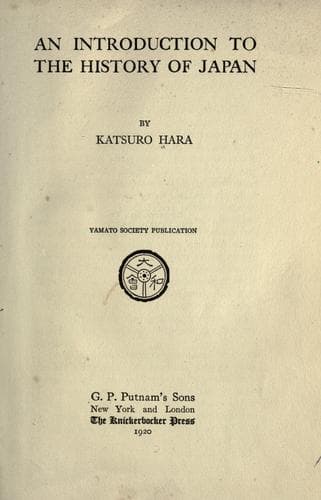
An Introduction to the History of JapanHara, Katsuro
History
An Introduction to the History of Japan
Hara, Katsuro
Japan -- History
Needless to say, the nation had had no voice in determining the
Shogunate's policy of "shutting up the country", and had not understood
well the merit or demerit of the policy itself, but having been
accustomed for a long time to the isolated national existence, and
puffed up not a little into self-conceit by the growth of the
nationalistic spirit, they were unconsciously induced to believe that
the status they were in must be the only normal condition of the
country. The people at large, though relieved of the overdue influence
of China, yet had a very scanty knowledge of the condition in which
Europe and America were at that time, and did not wish, in the least, to
be deranged by the intrusion, however well-meant, of any foreigner into
their quiet abode, in spite of the utter impossibility of continuing
such a national life _ad infinitum_ in the face of the changed
circumstances of the world, caused by the eastward expansion of various
European nations, and by the rise of a new power on the American
continent, the power which had just acquired access to the shore of the
Pacific. Those who were then at the helm of state, that is to say, the
statesmen of the Shogunate, shared nearly the same opinion with the
nation at large. Not only for the national welfare, but in the interests
of the Shogunate itself, they thought it best to keep up the _status
quo_ as long as possible. Unfortunately, the foreigners who now knocked
at our doors were not unarmed like those who had come two centuries
before, neither were they so humble and docile as the Dutchmen at
Deshima were accustomed to be. In order to keep them off in spite of
their importunate wish to the contrary, we had to provide for
emergencies. So the Shogunate tried to make military preparations, to
defend the country in case of necessity and drive away the intruders by
force of arms. The more, however, the Shogunate tried to arm the nation
against the foreigners, the more difficult it found the task it had in
view. As the result of the long enjoyment of peace, the people had
become inured to ease and luxury, and had lost much of their martial
spirit, of which they had been exceedingly proud as their characteristic
attribute. Moreover, the country having been parcelled out into nearly
three hundred territories, it was very hard for the Shogunate to
mobilise the warriors of the whole empire at its sole command. On the
other hand, the material progress of the Western nations, achieved
during the time of our seclusion, had been really astonishing. The
difficulty of coping with them now became far greater for us than it had
been at the end of the sixteenth century. Notwithstanding these
overwhelming difficulties, the Shogunate persisted in its endeavour to
strengthen the national defences. The martial spirit of the nation was
gradually reawakened, but new internal difficulties were created by thus
mobilising the nation, divided as it was into motley groups. The martial
Public-domain text, read in full here on John Shaqi.
Reviews
Reviews
No reviews yet
Be the first to share your thoughts on this work.
Elsewhere in the archive
Join the Discussion
Join the discussion
Sign in to leave a comment or review.
Sign InorCreate an account