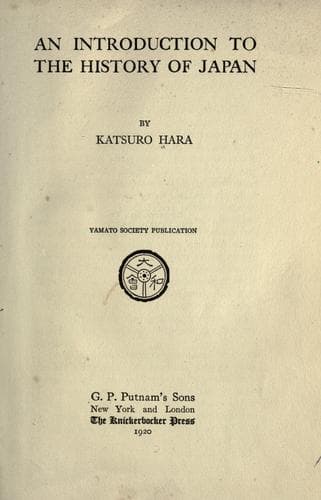
An Introduction to the History of JapanHara, Katsuro
History
An Introduction to the History of Japan
Hara, Katsuro
Japan -- History
spirit which the Shogunate aroused was turned against itself, and the
Shogunate proved unable to steer through the crisis at last.
At first the opinion of the educated class of the nation was
conflicting, but a few were eager to see the necessary overthrow of the
regime of the Shogun. The great part gradually concurred in denouncing
the incapacity of the Shogunate to fulfil by itself the task which it
was called upon to accomplish. Still many were in favour of supporting
the Shogunate in order to enable it to carry through its traditional
policy of seclusion. Some advocated even the closer union of the
Shogunate with the Imperial court, which was now beginning to become
again the influential political centre of the nation in opposition to
the power at Yedo, so that there might have been a fear of the two
powers coming into collision. The conclusion, however, of the treaty
with the United States in 1858, and subsequently with other powers,
bitterly disappointed these sincere friends of the Shogunate and
emboldened its adversaries. Hitherto those who had diametrically opposed
the Shogunate were men who had never been in any position politically
responsible. In other words, they were doctrinaires, and not men of
action, so that there could be no serious danger to the Shogunate so
long as they contented themselves only with arguing about national
affairs in highflown language. But the disappointment which the
Shogunate gave to its friends, turned them into sympathisers with the
radical opponents. The danger was thus shifted from foreign relations to
the serious internal question, whether the Shogunate should be allowed
to exist any longer or not. Those who wished for the revival of the
imperial prestige or the overthrow of the existing regime, whatever form
the revolution might take, wielded as their forcible weapon to attack
the Shogunate the denunciation that the sacred Land of the Gods had
been opened to the sacrilegious tread of hairy barbarians, and their
slogan was so persuasive that it led the imperial court at Kyoto to
issue an order urging the Shogunate to repudiate the already concluded
treaties and to return to the time-honoured seclusion policy, a task of
utter impossibility. To this august command from Kyoto, the Shogunate
could but respond very obsequiously, being intimidated somewhat by the
loud clamour of these conservative patriots. Or it may be said that the
military government succumbed to the combined force of the court-nobles
and the territorial politicians. The marriage of the fourteenth Shogun
to one of the sisters of the Emperor Komei, in the year 1861, though
concluded for the sake of the rapprochement of the Imperial court and
the Shogunate, did not prove so serviceable in saving the tottering
edifice of the Tokugawa regime as had been expected. Finding that the
power and the resources of the Shogunate were inadequate to perform the
duty which it had pledged itself to accomplish, Yoshihisa Tokugawa, the
Public-domain text, read in full here on John Shaqi.
Reviews
Reviews
No reviews yet
Be the first to share your thoughts on this work.
Elsewhere in the archive