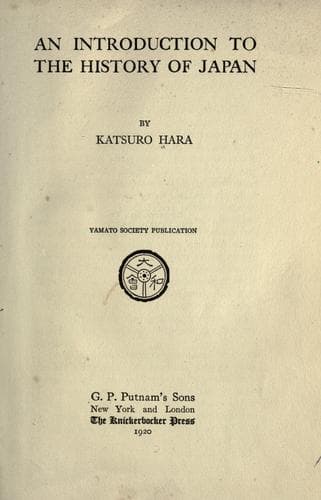
An Introduction to the History of JapanHara, Katsuro
History
An Introduction to the History of Japan
Hara, Katsuro
Japan -- History
It was none but the _samurai_, the mainstay of feudal Japan, who brought
about the momentous change of the Meidji, and it was the _samurai_ of
the lower class, who acted the chief part in the Revolution. The
savants, however they might have proved useful in fanning the
nationalistic spirit among the people, were after all not men of action.
Only the _samurai_, when permeated with this spirit, could effect such a
grand political change. There may be no doubt that the _samurai_
undertook the task for the sake of the national welfare, and most of all
not to restore the already rotten regime which had once existed before
the advent of the Kamakura Shogunate. But this evident truth was known
neither to the court-nobles, who dreamt only of seeing their past glory
recovered, nor to those idealists of ultra-conservative trend, who
sincerely believed that the history of nearly twelve centuries might be
simply ignored and the golden days of the Nara period be called back
into life once more. The latter strongly urged the personal government
of the Emperor and the restoration of the worship of the national gods
to its ancient glory, while the former strove to recover the reins of
government into their own hands. It was the result of their compromise,
that the political organisation of the Taiho era was formally revived,
though with not a few indispensable modifications. Think of the statute
of eleven hundred seventy years before recalled to reality again, and of
a country, governed by a such a petrified statute, entering the
concourse of the nations of the world in the nineteenth century. How
comical it would have been if such a retrogression had been allowed to
proceed even for a generation? The first to be disappointed were the
court-nobles. The expectation of the ultra-conservatives was also far
from being fulfilled. The country was in urgent need of a new
legislation conformable to the new state of things, and the restored
statute was soon found to be utterly inadequate to serve the purpose.
The quixotic movement of the bigoted Shintoists to persecute Buddhism,
which led to the lamentable demolition of many Buddhist sculptures and
buildings of high artistic merit, was to subside as soon as it was
started, for it was now the age of complete religious toleration, which
was extended even to Christianity soon afterwards.
Public-domain text, read in full here on John Shaqi.
Reviews
Reviews
No reviews yet
Be the first to share your thoughts on this work.
Elsewhere in the archive
Join the Discussion
Join the discussion
Sign in to leave a comment or review.
Sign InorCreate an account