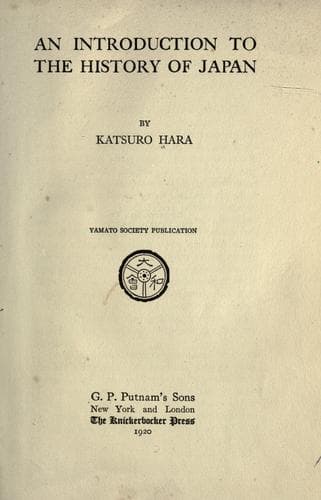
An Introduction to the History of JapanHara, Katsuro
History
An Introduction to the History of Japan
Hara, Katsuro
Japan -- History
The most extravagant expectation of the ultra-conservatives was thus
frustrated, but the conservative spirit in the nation, which was by no
means to be swept away at all found its devotees among the class of the
_samurai_. Though they were the real makers of the Revolution, yet the
loss of their privileges and material interests which it entailed,
touched them sorely. A very small fraction of them served the new
government as officials and soldiers of high and low rank, and could
enjoy life much more comfortably than they did in the pre-Meidji days.
The greater part of the _samurai_, however, were obliged to betake
themselves to some of the callings which they were accustomed to look
down upon with disdain, for if they did not work, the compensation which
they received from the government did not suffice to sustain them for
long. Some of them preferred to become farmers, and those who persisted
in that line generally fared well. Many others turned themselves into
merchants, and mostly failed; being accustomed to the simplicities of
the life and the code of soldiers, and utterly unversed in the
complexities of the code commercial, and the trickeries of the life
merchants; and the small capital obtained by selling their
compensation-bonds was soon squandered. What wonder if they began to
regret and whine for better days of the past? Discontentment became
rampant among them; but the inducement to its disruption was provided by
the diplomatic tension with Korea.
I have no space here to dwell upon the intricate history of the
differences between Korea and our country in the later seventies of the
nineteenth century. Suffice it to say that the militaristic party in and
out of the government favoured the war with Korea, while the opposing
party was against it, considering it injurious to sound national
progress, especially at a time when it was an immediate necessity for
the welfare of the country to devote all its resources to internal
reconstruction. The war party with Takamori Saigo at its head seceded
from the government. Saigo had been a great figure since the Revolution,
as the representative _samurai_ of the Satsuma, and had a great many
worshippers, so that even after his retirement his influence over the
territory of Satsuma was immense. At last he was forced by his adorers,
whose ill-feeling against the government now knew no bounds, to take up
arms in order to purge the government, which seemed to them too
effeminate and too radical. Not only the warlike and conservative
_samurai_ of Satsuma, but all the _samurai_ in the other provinces of
Kyushu, who sympathised with them, rose up and joined them. Siege was
laid by them to the castle of Kumamoto, the site of regimental
barracks.
Public-domain text, read in full here on John Shaqi.
Reviews
Reviews
No reviews yet
Be the first to share your thoughts on this work.
Elsewhere in the archive
Join the Discussion
Join the discussion
Sign in to leave a comment or review.
Sign InorCreate an account