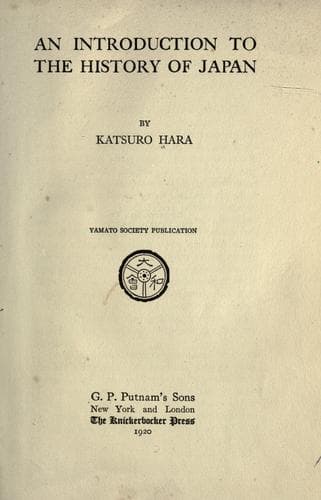
An Introduction to the History of JapanHara, Katsuro
History
An Introduction to the History of Japan
Hara, Katsuro
Japan -- History
Together with the climate, the race stands forth as an indispensable
factor in the promotion of its civilisation. Then to what race do the
Japanese belong? Can all the people of Japan be homogeneously comprised
under a single racial appellation, or must they be treated as an
agglomeration of several different races? Are the Japanese, or the bulk
at least of the Japanese, indigenous or immigrant? If the Japanese are
an immigrant race, then whence did they originate, and what is the
probable date of their immigration into this country? What race, if not
the Japanese, are the aborigines of these islands? Questions of this
kind, and others of a similar nature have stood waiting for solution
these many years! But none of them has yet been completely answered,
though attempts have been made not only by a large number of native
investigators, professional as well as amateur, but also by not a few
foreign philologists and archaeologists, who were tolerably well-versed
in things Japanese. Recently many interesting excavations of ancient
tombs and historical sites have been made, and various remains
pertaining to the old inhabitants of the islands have been submitted to
the speculative scrutiny of specialists. They have served, however,
rather to lead one to deeper, more obstinate, scepticism, than to shed
light on those doubtful and tentative answers and indecisive
controversies. It is very much to be regretted that we have no authentic
record of the early immigration into Japan from the pen of a
contemporaneous writer, so that we could thereby verify the
interpretations assigned to the remains found in the ancient tombs. This
is to be attributed to the lack of the use of written characters among
the aboriginal people, as well as to the illiteracy of the early
immigrants. If we had as remains of prehistoric Japan such valuable
historic materials as have been excavated in Europe and Western Asia, we
should have been able to deduce the history of its early ages with a
tolerable degree of certainty from the remains themselves,
independently of any documental evidence. Unfortunately, however, in
this respect also, our prehistoric remains consist only of a few kinds
of earthenware, mostly with very simple patterns on them, and some other
kinds of primitive utensils of daily use, such as saddles, bridles,
sword-blades, and the like. Huge tombstones are sometimes found, but
they have no such inscriptions as we see on many Greek sarcophagi, being
provided only with a few unintelligible, perhaps meaningless, scratches.
As to the primitive Japanese ornaments, very few historical data can be
gathered from them, for they are generally beads of very simple design,
and of three or four different shapes. It is quite hopeless to think
that we should ever be able to dig out a single dwelling, not to speak
of a whole palace, village, or town, on any Japanese historical site,
since no stone, brick or other durable material was ever used in the
construction of buildings.
Public-domain text, read in full here on John Shaqi.
Reviews
Reviews
No reviews yet
Be the first to share your thoughts on this work.
Join the Discussion
Join the discussion
Sign in to leave a comment or review.
Sign InorCreate an account