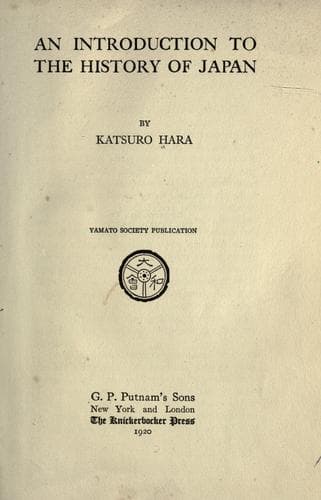
An Introduction to the History of JapanHara, Katsuro
History
An Introduction to the History of Japan
Hara, Katsuro
Japan -- History
What is unique in our modern history is that, parallel with the growth
of the democratic tendency in the nation, the imperial prestige effected
a remarkable increase. This seemingly contradictory phenomenon may be
explained easily by considering how our present notion of fidelity to
the Emperor has evolved. The divine authority of the Emperor did not
suffer any remarkable change after his personal regime ceased, though
his political prestige had been eclipsed by the assumption of power by
the Fujiwara nobles. Even after the establishment of the Shogunate,
nobody in Japan had ever thought it possible that the Emperor could be
placed in rank equal to or under a Shogun or any other sort of dictator,
however virtually powerful he might have been. Through all political
vicissitudes the Emperor has remained always the noblest personage in
Japan, and in this sense he has been the focus toward which the heart of
the whole nation turned.
The relation of the Emperor to the people at large, during these periods
of eclipse, was indirect. Between them intervened the Shogun and the
_daimyo_ as actual immediate rulers, so that fidelity to the Emperor had
been spoken of only academically, and their fidelity, in a concrete
sense, had been solely centered in their immediate master, who
reciprocated it by the protection he extended directly over them. Thus
fidelity on the one hand and protection on the other hand had been
conditioned by each other, and because the bond was naturally an
essential link of the military regime, it was strengthened by its being
handed down from generation to generation. In short, the fidelity of the
Japanese may be said to be a product of the military regime, and owes
its growth to the hereditary relation of vassalage. As all the ideals
and virtues cherished among the _samurai_ class used to be considered by
plebeians as worthy of imitation, if practicable in their own circles,
fidelity was also understood by them in the same sense as among the
military circles, that is to say, as a soldierly virtue in a subordinate
toward his superior. So it grew to be more disciplinary,
self-sacrificing and devotional, than in the times before the military
regime. This condition of the national morals had continued to the end
of the Tokugawa Shogunate, with occasional relaxations, of course. But
now that the Shogunate and the _daimyo_ were eliminated from the
political system, the foci toward which the fidelity of the people had
been turned ceased to exist, and the fidelity remained, as it were, to
be a cherished virtue of the nation though without a goal. It sought for
a new focus, looked up one stage higher than the Shogun, and was glad to
make the Emperor the object of its fervent devotion. Soon it developed
almost into a passion, because the nation became more and more conscious
of the necessity of a well-centred national consolidation, and it could
find nowhere else a centre more fit for it than the Emperor. His
Public-domain text, read in full here on John Shaqi.
Reviews
Reviews
No reviews yet
Be the first to share your thoughts on this work.
Elsewhere in the archive
Join the Discussion
Join the discussion
Sign in to leave a comment or review.
Sign InorCreate an account