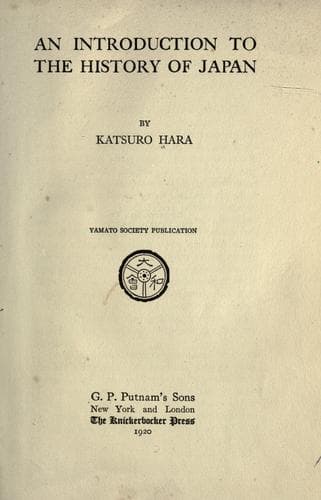
An Introduction to the History of JapanHara, Katsuro
History
An Introduction to the History of Japan
Hara, Katsuro
Japan -- History
So far they had been successful, but owing to insufficiency of
ammunition and provisions, they could not force their way much farther.
Moreover, the Imperial Army recently organised, recruited mostly from
the common people by the conscription system, proved very efficient,
owing to the use of Snider rifles, although at first the new soldiers
had been despised by the insurgents on account of their low origin. The
siege of Kumamoto was at last raised; the remnant of the defeated forces
of Saigo retired to a valley near the town of Kagoshima; Saigo committed
suicide; and the civil war ended in the victory of the government in
September 1877, seven months after its outburst.
This civil war is an epoch-making event in the history of the Meidji
era, in the sense that it was a death blow to the last and powerful
remnant force of feudalism, the influence of the _samurai_. Though the
_samurai_-soldiers who fought on the side of Saigo were very few in
number compared with the host of the _samurai_ within the whole empire,
and though not a few _samurai_-soldiers fought also on the opposite
side, still it was clear that the insurgents represented the interests
of the _samurai_ as a class better than the governmental army, and the
defeat of the former had, on the prestige of the class, an effect quite
similar to that which was produced in Europe of the later Middle Ages
by the use of firearms and the organisation of the standing army, and
significantly reduced the traditional influence of knights on horseback.
It is for this reason that the democratisation of the nation markedly
set in after the civil war, and with it the territorial particularism,
which had been weakened by the Revolution, has been rapidly dying away.
Political parties of various shades began to be formed. The works of
Montesquieu and Rousseau were translated into Japanese, and widely read
with avidity. The cry for a representative government became a national
demand. Against the hesitating government riots were raised here and
there. To sum up the history of the second decade of the Meidji era, we
see that it strikingly resembles French history in the first half of the
nineteenth century. The rise of the influence of the new-born bourgeois
class in modern Japan may be said to have dated from this epoch.
Europeanisation in manners and customs became more and more striking
year by year.
Public-domain text, read in full here on John Shaqi.
Reviews
Reviews
No reviews yet
Be the first to share your thoughts on this work.
Elsewhere in the archive
Join the Discussion
Join the discussion
Sign in to leave a comment or review.
Sign InorCreate an account